Unlocking the Cosmic Mystery: Dive into Avi Loeb’s Groundbreaking Discoveries on Anti-Tail and Tail Jets from 3I/ATLAS!

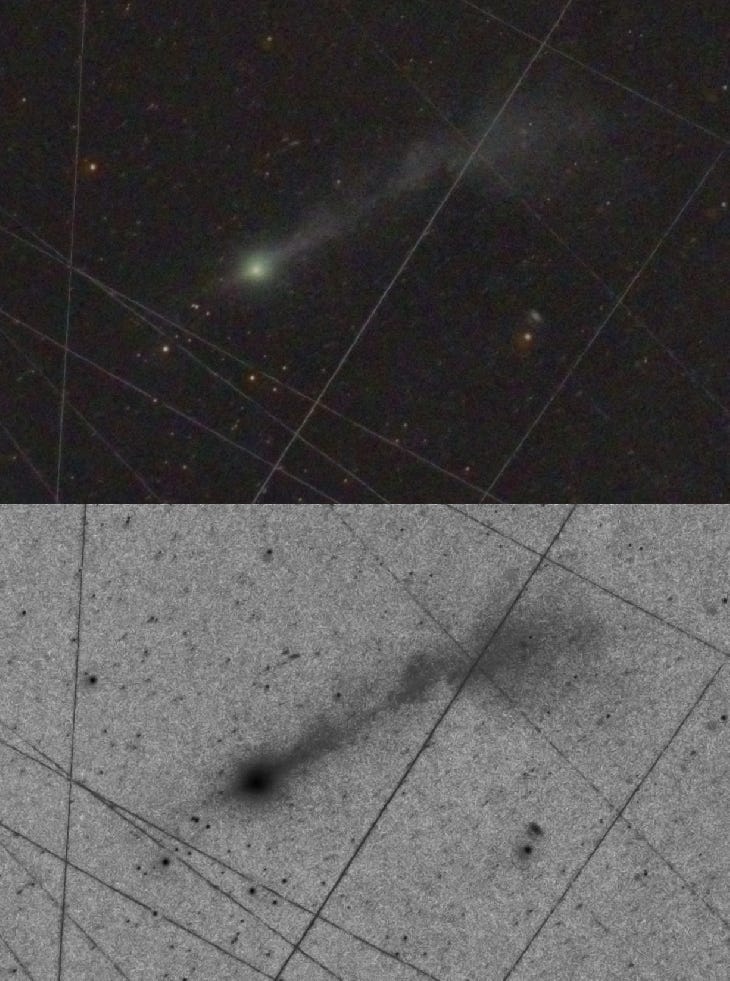
Astronomers Frank Niebling and Michael Buechner have unveiled a stunning new image of the interstellar object 3I/ATLAS, captured through a series of five 3-minute exposures between 5:08 and 5:22 UT on November 9, 2025. This impressive composite image was taken using two telescopes, revealing a complex structure of jets extending from the object. It highlights two anti-tail jets directed toward the sun and a longer collimated jet flowing away, with angular separations reaching approximately 30 arcminutes, roughly equivalent to the diameter of the Sun or Moon.
Currently, 3I/ATLAS is located about 326 million kilometers from Earth. This translates to a spatial extent of about 0.95 million kilometers for the sunward anti-tail jets and 2.85 million kilometers for the tail jet extending away from the Sun. Notably, these measurements are three orders of magnitude larger than the glowing halo captured by the Hubble Space Telescope in July 2025. As 3I/ATLAS nears its closest approach to Earth on December 19, 2025, at a distance of only 269 million kilometers, it presents a unique opportunity for future observations with both the Hubble and James Webb Space Telescopes.
However, the vast distances involved pose challenges for particle detection. Ground-based satellites and NASA’s Juno spacecraft, which will fly close to 3I/ATLAS on March 16, 2026, from 53 million kilometers away, are unlikely to capture particles from these jets. Similarly, the ESA’s Juice spacecraft, currently at 64 million kilometers from the object, will also miss the chance to study these phenomena.
The jets are theorized to have a natural outflow velocity of around 0.4 kilometers per second – the typical speed for gases at 3I/ATLAS’s distance from the Sun. This suggests that the jets must have been emitting for 3 months for the tail and around a month for the anti-tail. Strikingly, the persistence of these jets up to a distance of 1 million kilometers indicates that their ram-pressure surpasses that of the solar wind, which moves at approximately 400 kilometers per second. This extraordinary pressure means the outer mass density in the anti-tail jets is significantly higher than that of the solar wind.
Calculations suggest a mass loss rate of 50 billion tons per month from these jets, comparable to the minimum mass of 33 billion tons associated with 3I/ATLAS. Given the assumptions about its density, the object’s diameter must exceed 5 kilometers and possibly surpass 10 kilometers, assuming it is a natural comet. This points to an intriguing anomaly: the mass of 3I/ATLAS is over a million times that of the well-known interstellar object 1I/‘Oumuamua. Researchers posit that such a significant object should occur much less frequently than once every ten thousand years, raising questions about its origins.
If speculative technological explanations are considered, the jets could be linked to advanced propulsion methods rather than natural processes. Chemical rockets produce exhaust speeds significantly higher, suggesting that human-made technologies could account for the mass loss observed. Upcoming spectroscopic studies may clarify the composition and behavior of these jets, which would shed light on whether 3I/ATLAS is of natural or technological origin.
As the scientific community anticipates further observations, it stands ready to explore this foundational question about one of our solar system’s most enigmatic visitors. The humility to learn and investigate, rather than assume expertise, underpins the pursuit of knowledge in this exciting field of study.
Original Source: https://avi-loeb.medium.com/the-remarkable-large-scale-structure-of-anti-tail-and-tail-jets-from-3i-atlas-242c534cf7b3
Category :
Tags:
Publish Date: 2025-11-10 01:33:00