
In recent months, flight prices to and from Imphal have skyrocketed, causing significant frustration among the people of Manipur. What was once an affordable means of transportation has now turned into a luxury beyond reach for many.
For many residents, air travel is not a matter of convenience but a necessity. The state suffers from poor rail connectivity, and road travel has become increasingly unreliable due to ongoing ethnic violence. Key highways like NH-37 (Imphal–Silchar, approximately 250 km) and NH-39 (Imphal–Dimapur, around 215 km) traverse conflict-affected hill districts where movement is unsafe or entirely halted.
In such circumstances, those with urgent needs-students, patients, and workers-have no option but to rely on air travel. Unfortunately, this reliance has placed a significant financial burden on individuals already grappling with economic difficulties.
The ongoing conflict has severely undermined Manipur’s economy, dividing communities and disrupting markets that previously connected valley and hill districts. Supply chains have broken down, many businesses have shut their doors, and essential goods have become significantly more expensive. Daily wage earners are facing income loss, and small traders reliant on inter-district movement risk closure. Amid this economic instability, soaring flight fares add yet another layer of hardship.
Air travel once served as a vital link, connecting Imphal with key cities like Guwahati (490 km), Kolkata (1,350 km), and Delhi (2,400 km) for education, healthcare, and trade. However, with one-way tickets now costing Rs 10,000 or more, this crucial lifeline appears to be slipping away. Increasing distress and restricted mobility create a vicious cycle: those needing to leave are trapped, while those trying to import resources face logistical nightmares, further isolating the state economically and emotionally.
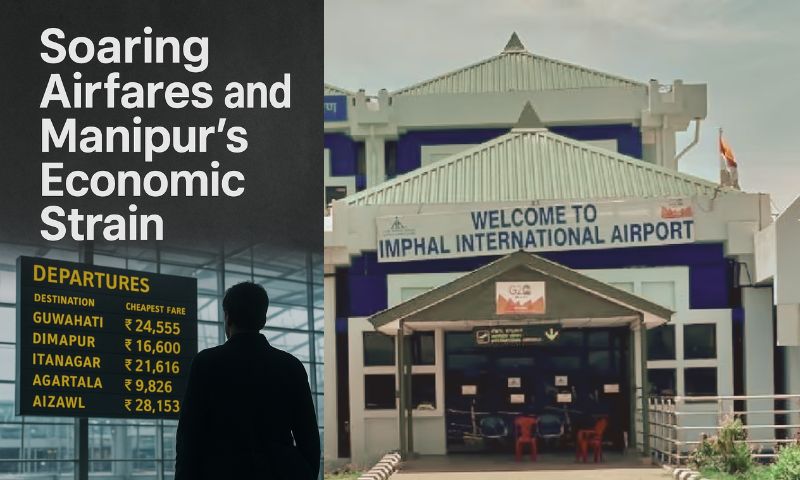
Flight fares have seen alarming fluctuations. For instance, the cost from Imphal to Guwahati jumped from Rs 24,555 to Rs 8,428 within two days, though it remains prohibitively high for such a short trip. Other routes show similar volatility; Imphal–Dimapur fares rose dramatically without the availability of direct flights, highlighting the challenges of connectivity in a conflict-ridden region.
Despite the short distances separating these Northeast capitals-ranging from 210 km to around 400 km, typically just a few hours by road-airfares can soar as high as Rs 20,000 to Rs 28,000, often surpassing long-distance flights to major cities like Delhi or Mumbai. Previously, airfares were between Rs 2,500 and Rs 5,000, yet they have surged to Rs 10,000 to Rs 15,000, with the number of daily flights plummeting from five to two, which further exacerbates the price hikes.
Political leaders have responded to this crisis. On October 1, 2024, Rajya Sabha MP Maharaja Leishemba Sanajaoba petitioned Union Minister K. Ram Mohan Naidu for a review of flight fares. In January 2025, then-Chief Minister N. Biren Singh called on the Central government to investigate rising fares, particularly for the Imphal–Delhi route. Lok Sabha MP Angomcha Bimol Akoijam accused the government of exploiting a tragedy-stricken populace in February, while MLA L. Susindro Meitei wrote to the Civil Aviation Ministry in November 2025, demanding action on fare regulation and increased flight frequency.
Amid this uproar, the Manipur Raj Bhavan recently expressed gratitude to the Ministry of Civil Aviation and Air India Express for their swift response to the fare crisis. After communication from the state governor, Air India Express decided to cap fares for the Imphal–Guwahati route at Rs 6,000 and announce the addition of two new daily flights.
However, even with capped fares, Rs 7,000 remains unaffordable for many residents. In the past, bus travel from Imphal to Guwahati cost only Rs 500 to Rs 1,000. The sudden shift from Rs 1,000 by road to Rs 10,000 by air is not merely inflation but a stark decline in equitable access to travel. This raises critical questions: Why are flight fares suddenly rising? Are airlines profiting from the suffering of the population? Why haven’t prices stabilized despite governmental intervention? How can ordinary citizens with dwindling incomes manage these costs? Furthermore, this pattern of neglect seems to alienate the people of the Northeast repeatedly.
The Ministry of Civil Aviation must take decisive action-market principles cannot govern pricing in a region lacking viable alternatives. Long-term relief would necessitate restoring road networks and completing the Jiribam–Imphal railway line to ensure affordable and safe travel options.
Soaring airfares reflect not only a transportation crisis but deep-seated economic inequality and regional neglect. For residents of Manipur, air travel is a lifeline, not a luxury. When this lifeline becomes financially unattainable, it effectively isolates an entire population. The government must act with strategy and sincerity to ensure that mobility becomes a right, not a privilege.
Original Source: https://nenow.in/opinion/soaring-airfares-the-unseen-cost-of-isolation-in-manipur.html
Category: Arunachal,Assam,Guwahati,Manipur,Mizoram,Nagaland,Opinion,Top News,Tripura,manipur,Soaring Airfares
Tags:
Publish Date: 2025-11-05 07:18:00