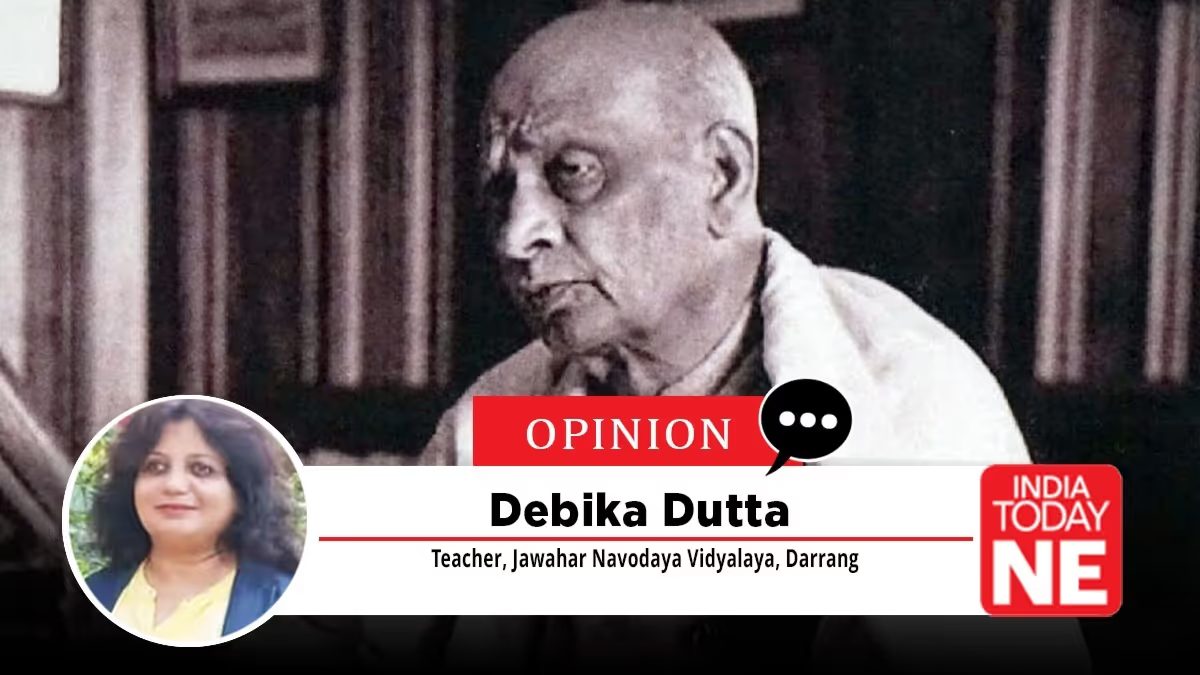

When India gained independence at midnight on August 15, 1947, the moment was both hopeful and precarious. Beneath the joyous celebrations lay a nation torn by division and trauma from the Partition. As the Union Jack lowered, over 565 princely states, each led by its own monarch, stood outside the control of the newly formed dominion. The question of whether India would unite as a single nation or fragment into various feuding states hinged on the actions of one man: Sardar Vallabhbhai Patel, India’s first Deputy Prime Minister and Home Minister.
Patel faced an overwhelming challenge. The British withdrawal left a dangerous power vacuum. The princely states, with ties to the Crown through treaties, were theoretically free to join India, Pakistan, or remain independent. Some rulers, motivated by personal ambition, entertained ideas of sovereignty, threatening India’s fragile unity. Patel’s unwavering clarity was essential in preventing the nation’s disintegration.
Armed with realism and administrative expertise, Patel acted decisively. He grasped the dynamics of power and persuasion, working closely with V. P. Menon, a key civil servant. Together, they developed the Instrument of Accession, a straightforward yet pivotal legal framework that enabled princely states to join the Indian Union in matters of defense, foreign policy, and communications. This instrument was fundamental to India’s unification.
By August 1947, Patel and Menon had successfully convinced most rulers to sign the Instrument. However, some states, most notably Junagadh, Hyderabad, and Kashmir, remained obstacles. Patel tackled each situation with a blend of diplomacy, firmness, and strategic insight, showcasing his political prowess and moral integrity.
Junagadh, a small state in Gujarat, had a Muslim ruler and a predominantly Hindu population that declared accession to Pakistan. Patel’s response was swift yet calculated. By imposing an economic blockade and engaging in political negotiations, he isolated the Nawab’s regime and led it to collapse. A plebiscite in February 1948 confirmed Junagadh’s accession to India, highlighting Patel’s ability to balance restraint with determination.
Hyderabad posed a larger challenge. The Nizam, supported by his militia, the Razakars, refused to join India and sought independence. For several months, Patel exhausted diplomatic efforts. However, as communal violence surged and national security came under threat, he authorized Operation Polo in September 1948-a swift military intervention lasting only five days. This operation successfully integrated Hyderabad into the Indian Union, restoring peace in the region. Patel’s actions demonstrated that unity required not just sentiment but resoluteness.
The situation in Kashmir was more complicated, influenced by geography, demographics, and external threats. Following a Pakistan-sponsored invasion in October 1947, Maharaja Hari Singh sought assistance from India. Patel insisted that formal accession was necessary before any intervention. Once the Instrument of Accession was signed, Indian troops were dispatched to defend the region. While Prime Minister Nehru managed diplomatic efforts, Patel concentrated on consolidating the state’s administration within the Union’s framework, demonstrating his urgency and clarity of action during turbulent times.
Beyond mere political integration, Patel envisioned a cohesive moral and institutional foundation for the new nation. As Home Minister, he oversaw the establishment of a unified civil service and integrated provincial bureaucracies into a cohesive system. He strengthened law and order and established the All India Services while guiding critical debates in the Constituent Assembly about governance and federalism. For Patel, integration was not just territorial; it also encompassed emotional and administrative dimensions.
Patel’s practicality distinguished him as a leader. He was more a practitioner than a theorist, whose realism often contrasted with Nehru’s idealism. Nehru envisioned a modern, democratic India, while Patel believed that unity and security were crucial prerequisites for progress. This ideological balance, though sometimes tense, shaped the early years of the Republic. Patel’s decisive actions, executed without seeking personal accolades, marked him as a leader who combined authority with humility.
Remarkably, Patel’s success in integrating the princely states often came without coercion. Over 560 out of 565 states joined India peacefully due to his persuasive capabilities and moral authority. The Chamber of Princes, previously a haven for feudal privilege, became a platform where Patel called upon a shared destiny, reminding rulers that independence without integration was “a short-lived dream of weakness.” His appeals were always nationalistic, devoid of vindictiveness.
By December 1950, when Patel passed away, India had turned into a coherent political entity, an unparalleled achievement in post-colonial history. Without Patel’s foresight, India could have fragmented like the Balkans or the divided Middle East. His efforts not only preserved territorial unity but also stabilized the political landscape, laying a crucial foundation for democracy and development.
Today, as India observes Rashtriya Ekta Diwas (National Unity Day) on Patel’s birth anniversary, his legacy underscores the notion that unity is a continuous act of courage, reason, and responsibility. The Statue of Unity, the tallest statue in the world located by the Narmada River, symbolizes Patel’s unwavering resolve and the mission to unite a fractured subcontinent into a nation founded on strength, integrity, and shared purpose.
Sardar Vallabhbhai Patel was primarily a realist who knew that freedom without unity is fragile. His true triumph lay not in conquest but in conviction-the belief that, despite its vast diversity, India could emerge as a singular nation. The monumental task of integrating princely states became the cornerstone of India’s destiny.
Original Source: https://www.indiatodayne.in/opinion/story/the-iron-architect-sardar-patel-and-the-challenge-of-integration-1297486-2025-10-31?utm_source=rssfeed
Category:
Tags:
Publish Date: 2025-10-31 11:06:00