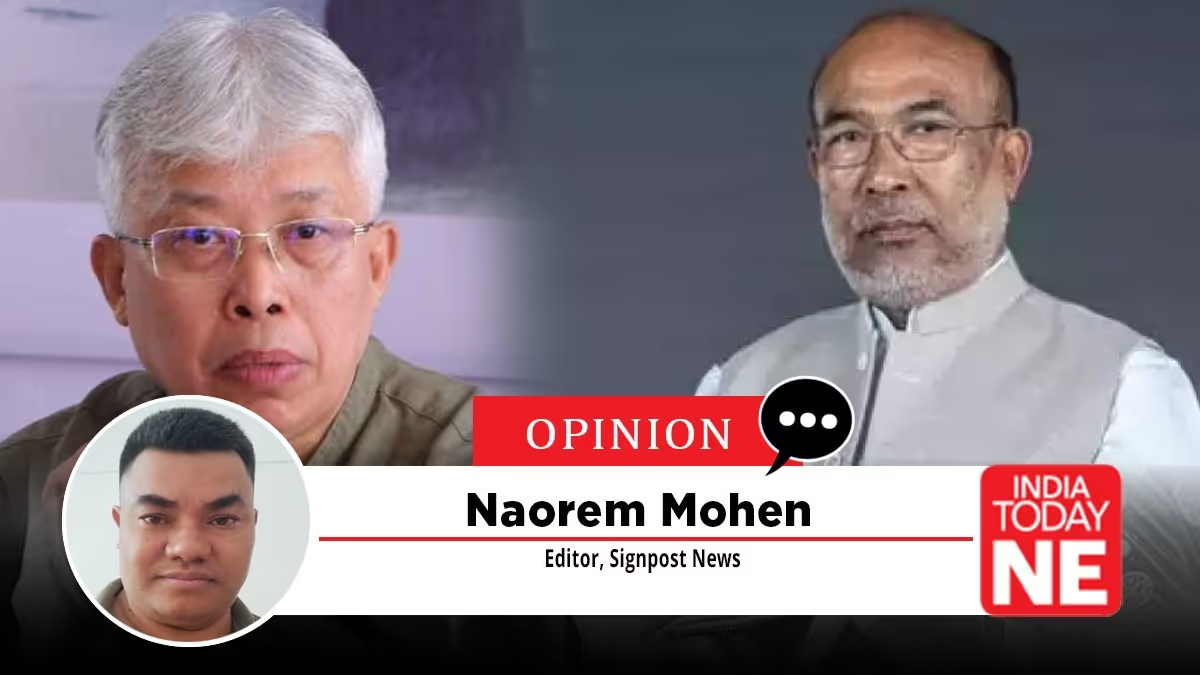

A bitter irony is unfolding in Manipur, where two Meitei leaders, once allies against a shared narrative of falsehood, are now fiercely attacking each other publicly. Former Chief Minister N. Biren Singh and Lok Sabha MP Angomcha Bimol Akoijam, who previously united in defense of their community, have transformed social media into a battleground.
What started as pointed critiques has now escalated into a full-blown war of words, broadcast live in a state already enduring 909 days of unrelenting conflict. This situation is not just political theater; it represents a profound betrayal of trust in a region under President’s Rule, where central governance highlights a breakdown of local leadership.
The fundamental question has shifted from who is right or wrong to a more painful dilemma: they fought together against Kuki misinformation-why are they now fighting each other?
Revisiting May 2023, when violence erupted, Biren positioned himself as the valley’s steadfast protector, viewing attacks on Manipur as an existential threat to its native inhabitants. From Imphal, he issued directives, rallied security forces, and spoke fervently about issues like “infiltration” and “narco-terrorism.” However, as chaos escalated, he became a scapegoat, reduced to a mere titular State Home Minister. A security advisor was appointed by the central government, leaving many to question his authority as Chairman of the Unified Command. If he held such a position, why could he not influence the deployment of state police alongside central forces to coordinate operations that might resolve the conflict within two to three months?
Despite challenges and accusations from Kuki MLAs and opposition factions, N. Biren Singh demonstrated proactive leadership by visiting relief camps, personally engaging with families displaced from violence in areas such as Tengnoupal, Churachandpur, and Kangpokpi. He also provided immediate financial assistance, advocating for inter-community harmony and collaborating with central authorities on compensation packages and peace-building initiatives.
Meanwhile, in Delhi, Bimol, armed with data, history, and eloquence, dismantled what he described as a one-sided national media portrayal. His intellectual prowess was especially evident during a memorable interview in June 2023 with veteran journalist Karan Thapar, where he delivered one of the most incisive defenses of Manipur’s narrative amidst rampant propaganda.
Faced with probing questions regarding the origins of the violence, Bimol challenged the dominant narrative that portrayed Meiteis as the aggressors, tracing the conflict back to colonial-era “divide-and-rule” strategies. He critiqued the selective outrage that seemed to amplify Kuki grievances while neglecting Meitei concerns over demographic changes and land encroachments-issues Biren had consistently highlighted.
Bimol also engaged with Kuki intellectuals and panelists on national television, meticulously refuting claims of Meitei “supremacy” by citing historical treaties, migration data, and the economic constraints imposed by Kuki militias on border trade. In one memorable exchange, he called out a Kuki academic’s assertion of “tribal victimhood” by exposing unreported arms flows from Myanmar, compelling the panel to acknowledge the complexity of the situation beyond simplistic blame.
Although never formally allied, the two leaders forged a two-front defense: one rooted in on-ground actions and the other in national discourse. The community recognized and believed in their combined efforts. However, today, memories of their collaboration feel like a cruel joke. Bimol has described Biren’s recent comments regarding the MP as “very childish,” and has frequently labeled Biren’s tenure as a “catastrophic failure,” implying that he is complicit in the chaos he once vowed to prevent.
Their conflict arises not from differing ideologies-both strive for Meitei integrity and cultural preservation-but from a toxic mix of ego, blame-shifting, and political maneuvering. By February 2025, audio tapes surfaced, leading Kuki groups to accuse Biren of being the “main perpetrator.” Even allies like the National People’s Party withdrew support in November 2024, citing his failure to restore calm. Internal dissent within the BJP from valley MLAs led to a looming no-confidence motion from Congress, alongside growing public anger following the Jiribam abductions.
Biren resigned on February 9, 2025, not as a villain evading responsibility, but as a sacrificial figure-pressured by the central government to prevent a collapse that could jeopardize the BJP’s fragile majority. His once-praised “strongman” approach, which succeeded in thwarting Kuki advances, became a scapegoat for ongoing unrest.
Bimol’s critiques, sharp in both media and parliamentary discourse, neglect to recognize Biren’s sacrifices, depicting him instead as an instigator rather than the burn victim of chaos. Observers, from the tense streets of Imphal to the overcrowded relief camps, see through the subterfuge. One elder at the Akampat Relief Camp expressed, “We don’t need their explanations. We need to go back.” This community has already made its judgment; no further rebuttal is necessary.
Bimol’s media victories, once echoing Biren’s warnings against “foreign influences” and media partiality, now seem hollow. At the heart of this fracture is a profound crisis of identity and geography, marked by “imaginary buffer zones” that divide the state-Sekmai for valley dwellers and Pallel for those heading south.
Beyond these checkpoints lies an atmosphere of fear: ambushes, kidnappings, blockades, and the looming threat of retaliation. For the Meiteis, the inability to travel freely along National Highway 2 poses not just logistical challenges, but existential ones. These routes were once lifelines, facilitating commerce from Moreh and aspirations from Imphal to the wider world.
As Biren and Bimol trade barbs online, the highways remain cut off, businesses in Moreh are at a standstill, and about 70,000 displaced individuals find themselves in limbo. Social media, initially a weapon against Kuki propaganda, has morphed into a coliseum of their conflict. Biren’s post-resignation speeches brim with nationalist rhetoric, while Bimol’s rebuttals remain sharp, scholarly, and unyielding, leveraging his interview with Thapar to scrutinize Biren’s legacy.
Supported by their respective followers, these exchanges ring aloud. Yet, in the relief camps of Imphal and Kangpokpi, where families share meager rations to survive each day, such battles feel trivial and far removed from their plight. A “like” on social media does not feed a child, nor does a retweet reopen a highway.
Under President’s Rule-imposed in February 2025 after Biren’s resignation-the stakes are survival, not spectacle. The Union government observes. Security forces await. The people grow weary, grappling with the repercussions of Biren’s sacrifices and Bimol’s once-valuable rhetoric, now turned against their kind.
The urgent call is not merely for abstract unity; it is about prioritizing Meitei identity over political pursuits. Envision a Meitei Leipung Phamba not in the comfort of Delhi’s air-conditioned spaces, but on the open grounds of Imphal, perhaps at the Kangla. Biren, Bimol, and their peers must convene-not to assign blame, but to produce tangible outcomes.
Their priority? To reopen both highways with synchronized security patrols and ensure the safe return of displaced individuals to their homes. This is not unrealistic; it is practical.
The citizens of Manipur do not perceive Biren and Bimol through the lens of party affiliation; they see them as Meitei leaders who once battled a common foe using different strategies. The focus is not on debates; it is on restoring normalcy: displaced people returning home, commerce resumed in Moreh. They yearn for active highways-where traders can negotiate, and life can flourish once again.
Let Biren take charge on the ground, and allow Bimol to advocate in Delhi. But they must collaborate, as they once did-Biren standing against Kuki militants while Bimol combats prevailing media myths.
Only after normalcy returns should the 2027 campaign commence. The public can then determine who was the more effective leader. But for now, it’s vital-for the sake of Manipur-to cease the jabs, silence the keyboard battles, and reclaim the roads. Remember: they fought Kuki misinformation together. Now, they must collectively strive for Manipur. Let them visit the relief camps side by side, not as adversaries, but as the duo that once weathered the storm.
Biren and Bimol, powerful figures in their own right, possess the capability to steer the situation towards resolution. Will they rise to the occasion? The populace watches, not with ire but with waning hope. In a state where each new dawn carries the threat of renewed violence, unity is not a choice; it is a necessity. Let this exchange of words mark the end of division, replaced by the cohesive rhythm of solidarity. For the future of Manipur, this must be the path forward.
Original Source: https://www.indiatodayne.in/opinion/story/they-fought-kuki-lies-together-why-fight-each-other-now-1296169-2025-10-28?utm_source=rssfeed
Category:
Tags:
Publish Date: 2025-10-28 13:28:00