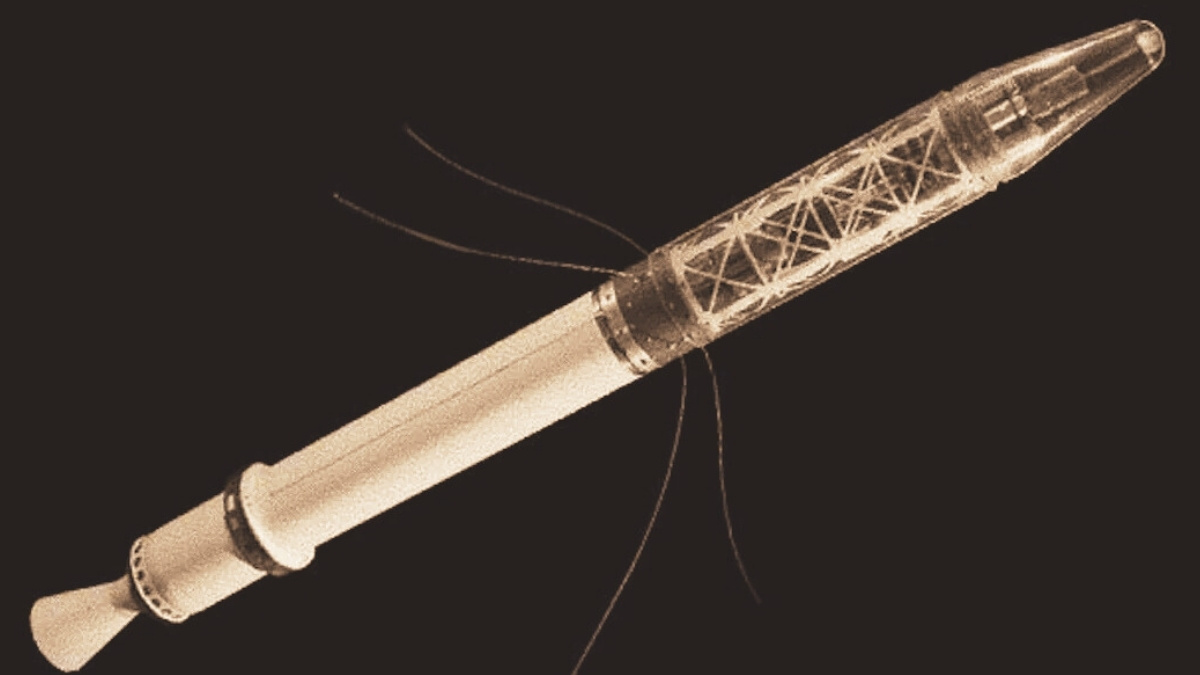

On January 31, 1958, the United States launched its first satellite, Explorer 1, at 10:48 p.m. Eastern Standard Time from Cape Canaveral, Florida. This pivotal moment in American space history came just months after the Soviet Union’s successful Sputnik missions, marking a crucial step for the U.S. in the growing space race during the Cold War era. Built by the Jet Propulsion Laboratory, Explorer 1 was the first successful U.S. satellite mission, signifying America’s formal entry into the realm of space exploration.
Equipped with scientific instruments developed by physicist James Van Allen and his team, Explorer 1 made a significant contribution to science by discovering the Van Allen radiation belts-regions of charged particles trapped by Earth’s magnetic field. This groundbreaking discovery solidified the mission’s historical importance. The satellite entered a highly elliptical orbit, completing an orbit roughly every 114 minutes, and operated for approximately four months, during which it transmitted critical data that included measurements of cosmic ray intensity variations and the detection of micrometeorite impacts.
Explorer 1 launched aboard a Juno I rocket, a key component in restoring American confidence following earlier setbacks in space technology. Its success laid the groundwork for subsequent satellite programs and spurred discussions about Earth’s space environment and the potential hazards of radiation. The mission involved close cooperation among scientists and engineers and served as an integral part of the International Geophysical Year efforts, underscoring the collaborative spirit of global scientific inquiry despite the tense backdrop of the Cold War.
After more than 12 years in orbit and over 58,000 completed revolutions around the Earth, Explorer 1 re-entered the atmosphere on March 31, 1970, and burned up upon re-entry. While the satellite is no longer in space, its legacy continues to influence research in space science and American space missions. The discoveries made by Explorer 1 remain a cornerstone of our understanding of Earth’s magnetic field and radiation dynamics, laying a foundational framework for future explorations and satellite technology.
As we commemorate Explorer 1’s launch and celebrate its contributions, it is vital to recognize how far space exploration has come since that historic day. The pioneering spirit that propelled Explorer 1 and its team has ensured that the pursuit of knowledge and understanding of our universe continues to thrive. The scientific inquiries spurred by this early mission have led to ongoing advancements, influencing a new generation of satellites and exploratory missions that seek to uncover the mysteries of space.
In conclusion, Explorer 1 not only marked America’s entrance into the space race but also highlighted the importance of scientific discovery during a critical juncture in history. Its mission catalyzed further research and exploration, cementing its place as a milestone in the timeline of space exploration. The impact of Explorer 1 persists today as we continue to reach for the stars, driven by the same desire for knowledge and discovery that defined its launch.
Categories: Space Exploration, Historical Milestones
Tags: Explorer 1, NASA, Van Allen Belts, Space Race, Cold War, Satellite Technology
Original Source: https://www.jagranjosh.com/us/explainers/first-us-satellite-1860001235
Category :
Tags:
Publish Date: 2025-09-22 21:30:00