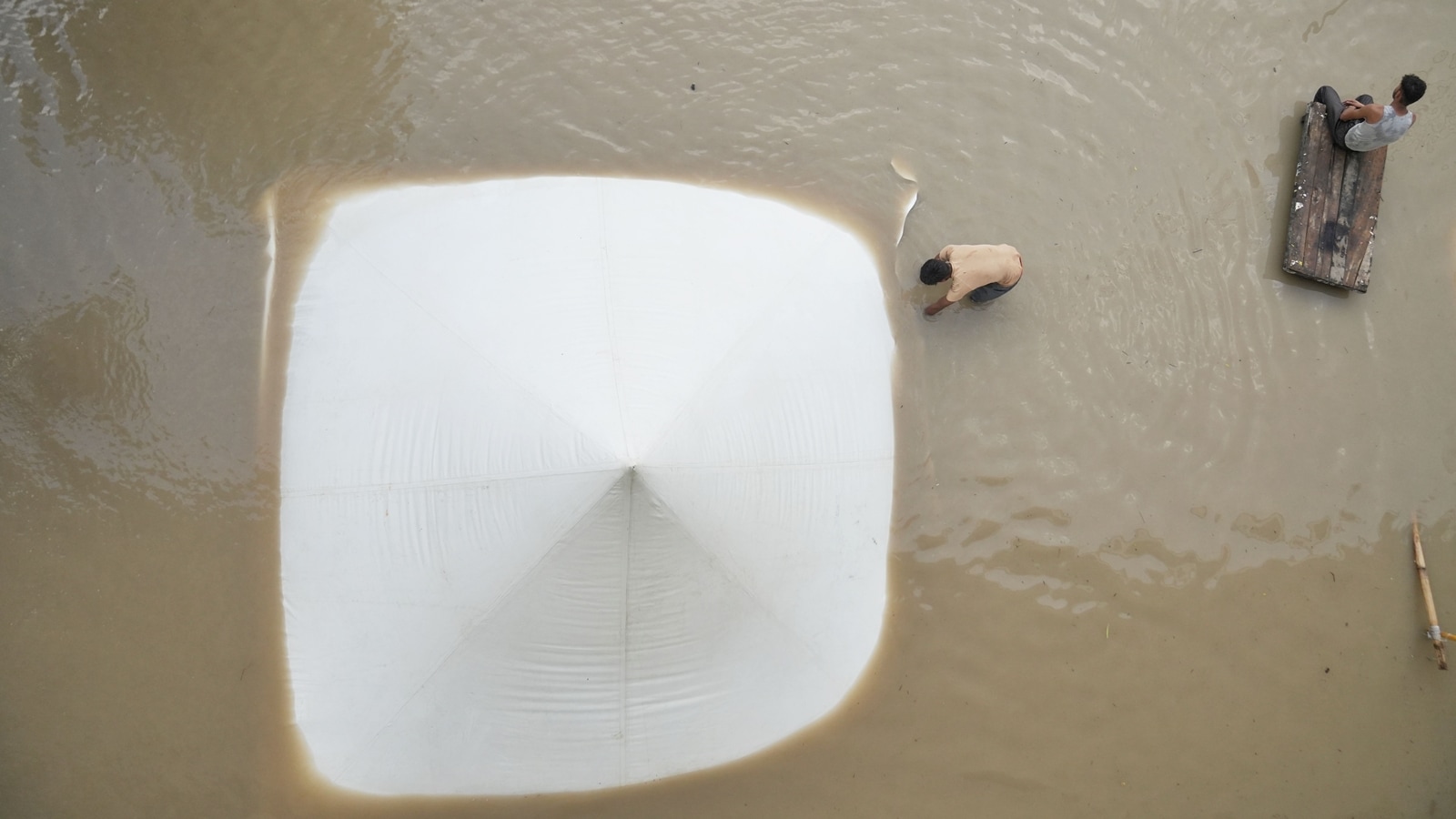

“Let’s wait for it to get darker, then we will go,” Soni told her 17-year-old daughter at a relief camp in Mayur Vihar on Thursday evening. With no functional toilets available, Soni, her two daughters, and her sister-in-law Muskan, who is seven months pregnant, have had to venture out every morning around 3-4 AM to find a place to relieve themselves near the banks of the rising Yamuna River or under a flyover.
Pointing to the traffic jam beside the Mayur Vihar Metro station, Soni expressed her frustration, saying, “Look how many vehicles are passing by. There are many people near the river. How will we go now?” This is just one of the challenges faced by families currently sheltering in the over 500 tents that have been erected across at least 38 locations in six flood-prone districts as Yamuna floodwaters have inundated their neighborhoods. In addition to the lack of toilets, many families are grappling with shortages of drinking water, food, and overcrowding.
Chanda, 30, seated on a roadside chair at Old Usmanpur, shared her difficulties, stating, “I had to walk 30 minutes to Shastri Park to use the toilet. There is no drinking water here either.” The area, she noted, is littered with dung from cattle belonging to the displaced residents.
Officials from the district administration reported that portable mobile toilets are being set up at the camps, but relief efforts have been hampered. As of Thursday evening, teams from Delhi Fire Services continued to evacuate residents from partially submerged homes in the area.
Ganesh Kumar, a 50-year-old ragpicker, recounted his experience after being rescued along with two roommates, stating, “We didn’t expect water to reach this high. We tried moving our things to higher platforms, but the water surrounded us by night. We stayed on the roof until the boat came.”
In Mayur Vihar Phase I and Yamuna Bazar, floodwater has inundated tents, worsening the plight of those displaced. Meanwhile, the Old Iron Bridge has become a makeshift shelter for nearly 300 rescued cows, after a local gaushala was submerged by rising water.
The cow rescue operation resembled a chaotic version of the traditional Jallikattu sport, with at least ten men shouting as they struggled to control the cows, eventually loading them onto a motorboat. Veterinary staff Sakruddin Sheikh, who has been caring for the cattle for a decade, confirmed they managed to transport about 300 cows to safety, where they are being provided with medicines and food to prevent hypothermia.
In the midst of this turmoil, Maya Devi, sheltered on the roadside, voiced her frustrations about overcrowding, saying, “There are no tents for us.” Another woman chimed in, expressing despair over their situation: “We neither have a place to stay nor food to eat.” Police noted that rain had delayed the tent setups, with food primarily being distributed at the Shastri Park relief camp.
Rescue operations have also caused tensions. Each boat can carry only 8 to 10 people, making it challenging for officials to maintain order. Patparganj MLA Ravinder Singh Negi was seen urging residents to avoid crowding the riverbanks, while NGO workers requested priority for rescuing stranded dogs.
The situation at Nigambodh Ghat, the city’s largest cremation ground, remains dire, as it continues to be underwater after an 8-foot boundary wall collapsed. Although the Municipal Corporation of Delhi suspended cremations, families are still attempting to carry their deceased to the half-submerged site. Jatin Rajput, 23, came all the way from Pratap Nagar to cremate a 50-year-old relative, saying, “Our family always comes here for the last rites… We are now thinking of going to Punjabi Bagh.”
Afdesh Sharma, the ghat in-charge, recalled how the site was closed for nearly a week during the 2023 floods. “Three tractors have been put in place to pump out water… hundreds of cement bags are being used to prevent further flooding,” he said. Other ghats in the city have also faced similar issues, with platforms at the Geeta Colony cremation ground completely submerged. Sanjay Sharma, the ghat in-charge there, reported that around 14 cremations still took place, with families using narrow pathways to perform the necessary rituals.
“This is not just about infrastructure; it is about dignity in death,” remarked Shankar Kumar Ranga, a member of the Nigambodh Sanchalan Samiti. “But what can we do? Nature has taken its course.”
Original Source: https://indianexpress.com/article/cities/delhi/displaced-look-for-toilets-food-water-and-shelter-as-rise-in-yamuna-levels-wreaks-havoc-10231067/
Category: Cities,Delhi
Tags:
Publish Date: 2025-09-05 04:52:00