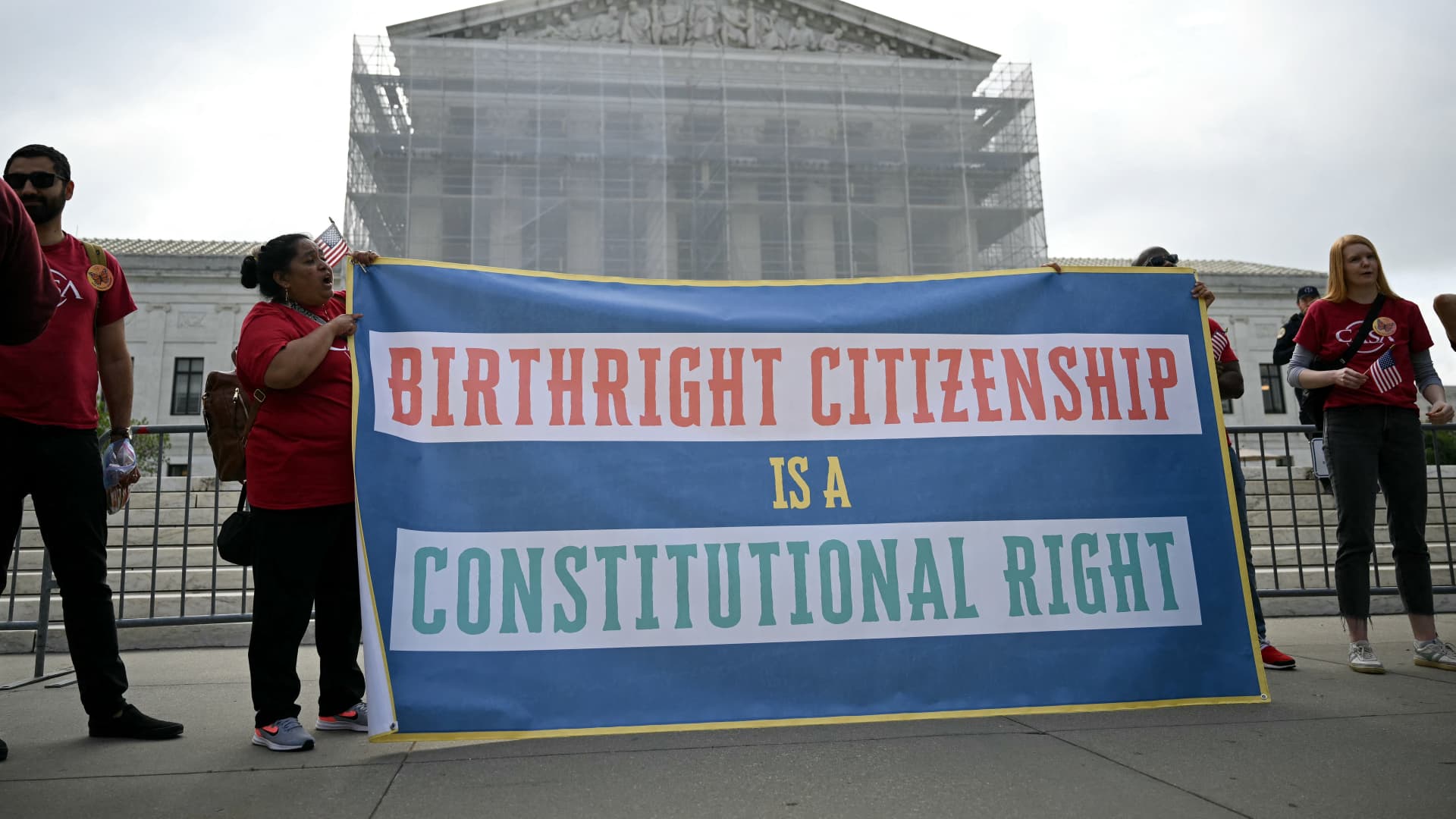
Supreme Court Strikes Down Judges’ Authority: A Groundbreaking Blow to Trump’s Birthright Citizenship Order!

The Supreme Court has significantly limited the power of federal judges to issue universal injunctions, a ruling that directly affects President Donald Trump’s efforts to end birthright citizenship. In a 6-3 decision delivered on Friday, the Court’s conservative majority addressed the contentious issue of nationwide injunctions that had been granted in response to three lawsuits challenging Trump’s executive order.
The ruling paves the way for the Trump administration to advance its agenda to reshape established U.S. citizenship norms. The decision also reinforces Trump’s assertions that judicial overreach has hindered his use of executive authority. Following the announcement, Trump took to social media to celebrate, declaring it a “GIANT WIN in the United States Supreme Court!”
At the core of the case was the legality of the nationwide injunctions, which previously halted the enforcement of Trump’s controversial citizenship order as litigation unfolded. The Supreme Court clarified that universal injunctions may exceed the equitable powers Congress has allocated to the federal courts. The majority’s opinion allows the Trump administration to seek a pause on these injunctions “only to the extent that the injunctions are broader than necessary to provide complete relief to each plaintiff with standing.”
Importantly, the Court refrained from determining the constitutionality of the executive order itself, which seeks to alter a long-standing practice of granting citizenship to those born on U.S. soil. Justice Amy Coney Barrett, writing for the majority, remarked, “When a court concludes that the Executive Branch has acted unlawfully, the answer is not for the court to exceed its power.”
In sharp contrast, Justice Sonia Sotomayor issued a strong dissent, voicing her concerns over the implications of curtailing universal injunctions. She criticized her conservative colleagues for supposedly enabling what she termed judicial “gamesmanship” by the Trump administration. “No right is safe in the new legal regime the Court creates,” she asserted, warning that the current threat to birthright citizenship could set a precedent for future administrations to undermine other rights.
Sotomayor’s dissent, supported by Justices Elena Kagan and Ketanji Brown Jackson, emphasized that the abolition of birthright citizenship starkly contradicts established law. She expressed alarm that, under the majority’s ruling, “tomorrow, a different administration may try to seize firearms from law-abiding citizens or prevent people of certain faiths from gathering to worship.”
Justice Jackson further emphasized the gravity of the situation in her dissent. She characterized the majority’s ruling as an invitation for the Executive Branch to contravene the Constitution against individuals who haven’t yet initiated lawsuits. “In my view, if this country is going to persist as a Nation of laws and not men, the Judiciary has no choice but to deny it,” she concluded.
This landmark ruling not only shifts the landscape for future executive actions but also raises pressing questions regarding the balance of power among the branches of government. As the implications of this decision unfold, it draws attention to the ongoing debate over judicial authority and the scope of executive power in America.
Original Source: https://www.cnbc.com/2025/06/27/supreme-court-trump-birthright-citizenship-case.html
Category :
Tags:
Publish Date: 2025-06-27 22:37:00