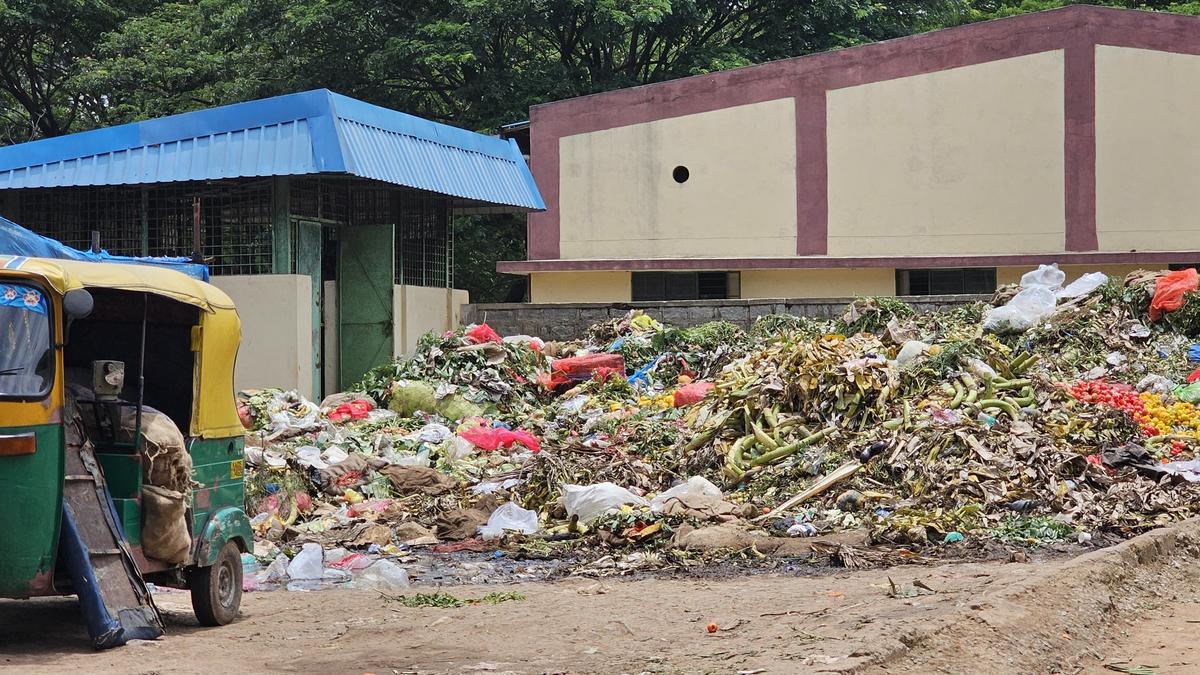

Stepping into an open vegetable market in Bengaluru during monsoon can be a shock to the senses. A wave of unbearable stench greets you, emanating from mountains of rotting waste, while slushy pathways make navigation difficult. This grim scenario has become all too common in various markets across the city, from Banashankari to HAL and beyond. Despite the urgent need for cleanup, the situation reveals deeper systemic failings in waste management.
At the heart of this chaos is a regulatory neglect that has led markets like the once-bustling HAL Market to deteriorate. The sight of a massive pile of wet waste at the market’s entrance is merely a precursor to the abysmal condition inside. Slippery paths and puddles become obstacles for shoppers, especially after a rainfall. While weekends see a surge in visitors, weekdays often leave the markets eerily empty.
Mukunda N.S., founder of Bengaluru Praja Vedike, highlights the gravity of the waste management crisis. “The waste must be cleared efficiently, not randomly,” he asserts. He advocates for a robust, permanent waste-clearing mechanism in all markets, ideally operating every couple of hours, particularly during festivals. With the BBMP charging a solid waste management fee from businesses, Mukunda insists that these funds should be allocated to improve collection and transport systems, overseen by a committee for greater accountability.
The Banashankari market faces its own challenges with waste piling up hourly, cleared only sporadically. To alleviate the congestion, a proposal to construct a multi-exit underground plaza with 150 stalls was suggested but has yet to see progress.
Plastic pollution is another pressing concern for these markets. Shanthi Tummala, a member of the Solid Waste Management Round Table, bemoans the continued use of plastic despite a ban enacted in 2016. “If vendors collectively agreed to stop providing plastic covers, the change would be swift,” she notes. Encouraging buyers to bring their own bags and selling cloth and paper alternatives is essential for sustainability. Furthermore, eliminating plastic also has financial benefits for vendors, allowing saving of significant monthly costs.
Local processing of wet waste is a feasible and sustainable solution, according to Shanthi. She urges authorities to invest taxpayers’ money into initiatives like composting and biogas locally within market premises as a pilot project.
Several open markets, particularly in Hebbal and K.R. Puram, are facing severe congestion issues due to poor planning and infrastructure. These areas are often overwhelmed by heavy traffic and vendor stalls, exacerbated by ongoing construction projects.
An underground market recently opened in Vijayanagar has faced operational challenges, with over 25 vendors occupying the space without official sanction. Built for ₹13 crore and inspired by New Delhi’s Palika Bazar, it has become largely overlooked due to inadequate facilities, poor ventilation, and negative environmental impact from tree cutting during construction.
Efforts by the BBMP to create multi-storied markets have also come under scrutiny. Critics argue that demolishing established markets like the one in Malleswaram fails to consider the needs of local consumers and disrupts longstanding community practices. With many built markets now being dismantled, residents question the practicality of these new structures as they grapple with the loss of amenity and convenience.
To address these pressing issues, stakeholders in Bengaluru’s markets must prioritize effective waste management, community engagement, and sustainable practices. The future of these vital commercial spaces depends on concerted action to transform not just their appearance but also their operational efficacy.
Original Source: https://www.thehindu.com/news/national/karnataka/no-public-friendly-markets-or-market-friendly-waste-disposal-in-bengaluru/article69624047.ece
Category : Karnataka
Tags:
Publish Date: 2025-05-28 09:00:00