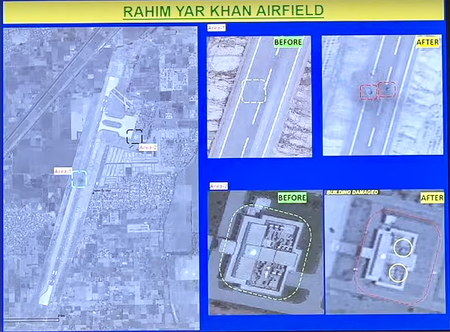

India has launched a significant military operation, dubbed Operation Sindoor, targeting terrorist camps along the Line of Control (LoC) in Pakistan. This operation resulted in the destruction of fifteen key sites associated with extremist groups. Evidence from satellite imagery, analyzed by OSINT expert Damien Symon, has validated the extensive damage inflicted on major Pakistani air bases.
Among the notable targets was ‘Markaz Subhan Allah’ located in Bahawalpur, recognized as the main training hub for Jaish-e-Muhammed (JeM). Another critical site was ‘Markaz Taiba’ in Muridke, near Lahore, which served as the headquarters for Lashkar-e-Taiba (LeT), infamous for the 2008 Mumbai attacks. The strike also hit ‘Mehmoona Joya’ in Sialkot, a base for Hizbul Mujahideen (HM), known for sending militants into Jammu and Kashmir. Additional locations such as ‘Sawahi Nallah Camp,’ ‘Markaz Syedna Bilal,’ ‘Markaz Abbas Kotli,’ and ‘Markaz Ahle Hadith’ were also targeted.
These airstrikes were a response to a series of cross-border drone incursions and targeted attacks. The operation, lasting over three days, featured Indian fighter jets conducting precise strikes on nine terror hubs in both Pakistan and Pakistan-occupied Kashmir (POK). This military action was directly prompted by a terrorist attack in Pahalgam on April 22, which claimed the lives of 26 civilians, all of whom were tourists. LANDSAT images dated May 10 indicated significant damage at Sargodha Airbase, notably to runway 14/32.
Meanwhile, Rahim Yar Khan Airbase has been rendered non-operational, with a NOTAM issued until May 17. Strikes on Nur Khan, Bholari, and Jacobabad Airbases have further weakened Pakistan’s military infrastructure, targeting essential facilities and radar systems. Following sustained Indian airstrikes, the Director General of Military Operations (DGMO) in Pakistan urgently contacted his Indian counterpart at 3:30 PM on May 10, seeking a ceasefire.
India agreed to the ceasefire but only after executing a calculated military response. A panel of senior defense officials later reported that India eliminated “100 terrorists across nine locations,” which included “three high-profile operatives” linked to the Kandahar hijacking and the Pulwama attack. The panel also confirmed that there was no violation of airspace by the Pakistan army.
In a press briefing, key defense officials, including Lieutenant General Rajiv Ghai, Vice Admiral AN Pramod, and Air Marshal Awadhesh Kumar Bharti, provided updates on Operation Sindoor. They emphasized that the operation targeted Pakistan’s core military assets, including command and airbase structures in places like Chaklala, Rafiki, and Rahriyar Khan. Officials reinforced India’s commitment that any aggression would face immediate retaliation.
Lieutenant Gen Ghai stated, “The response will be fair and punitive.” The operation also neutralized radar installations at Pasrur and Sialkot while striking significant military targets in Rawalpindi, Rahim Yar Khan, Sukkur, and Sunia using precision air-launched munitions.
Compounding the conflict, Symon revealed Pakistan’s misinformation campaign, showcasing doctored images intended to misrepresent damage to Indian military installations. Among these was an outdated photo of Jammu Airport, falsely circulated as evidence of recent destruction.
Original Source: https://theshillongtimes.com/2025/05/12/satellite-evidence-india-destroyed-15-terrorist-camps-including-let-headquarter/
Category: INTERNATIONAL,NATIONAL,News Alert
Tags:
Publish Date: 2025-05-12 21:01:00