
In a move that is raising eyebrows across the globe, the U.S. government’s decision to reduce support for research institutions and threaten federal funding to universities like Harvard and Columbia has sparked a strategic shift in Europe. European leaders, seizing what they’ve termed an American “error” and “gigantic miscalculation,” are actively working to attract scientific talent.
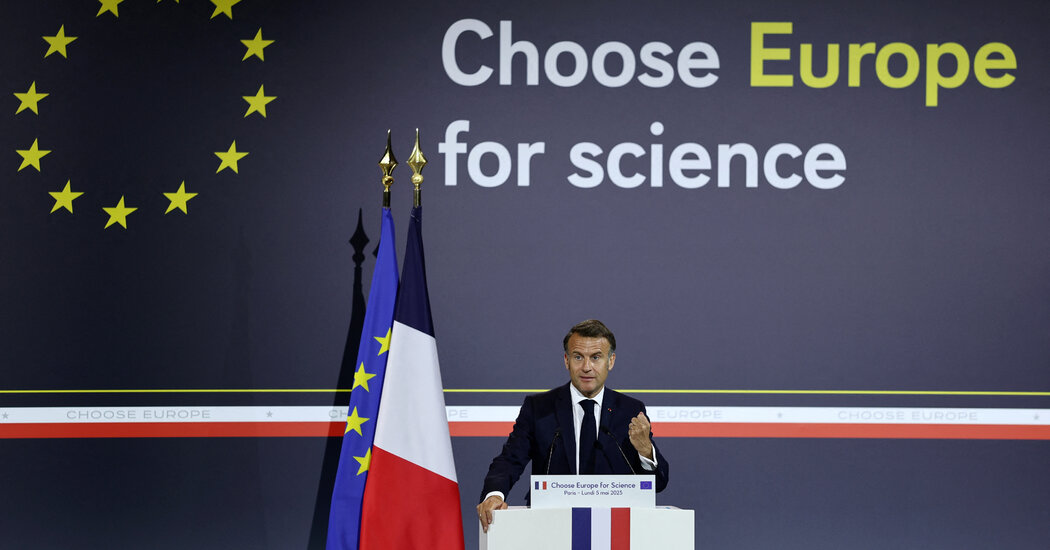
Speaking at the Choose Europe for Science event at Sorbonne University, French President Emmanuel Macron expressed disbelief at the U.S.’s withdrawal from key research initiatives, especially those linked to diversity. Highlighting the irony, Macron noted that a nation whose economy thrives on free science would undermine its own research sector. Macron underscored an unthinkable moment, reflected also in the U.S.’s withdrawal of researchers’ visas, which he sees as a strategic error.
Ursula von der Leyen, President of the European Commission, endorsed Macron’s views without overtly naming the U.S. She announced a substantial $566 million investment to position Europe as a leading hub for global researchers, emphasizing the value of “fundamental, free and open research.” She underscored the error in questioning such research, echoing a sentiment of miscalculation.
The conference emphasized the perception that the Trump administration has distanced America from its foundational principles of liberty and democracy. This shift, viewed by many in Europe as an assault on academia, is seen as an opportunity to bolster Europe as an attractive destination for researchers. Europe aims to reinforce its universities and maintain its status as a bastion of independent scientific thought.
Long-term plans were unveiled by the European Commission to double grants for researchers relocating to Europe and incorporate freedom of scientific research into the forthcoming European Research Area Act. Von der Leyen stressed that maintaining open and free science is Europe’s distinct attribute, ensuring that Europe remains a defender of academic and scientific freedoms globally.
The impetus for the conference came from the Trump administration’s reductions in science funding and perceived attacks on diversity initiatives within academia. Such policies have positioned the U.S. as a strategic adversary, prompting Europe to welcome American researchers as a countermeasure.
Macron extended a message to scientists, particularly women, inviting them to support Europe’s commitment to freedom. He pledged $113 million from the French government to integrate foreign researchers, promising to complement rather than replace European scientists.
Alarm bells rang in Europe when the Trump administration implemented severe budget cuts and froze scientific grants at leading U.S. institutions under cost-saving measures. Anger grew over the administration’s attempts to control university admissions, hiring, and areas of study, as criticized by Harvard President Alan M. Garber.
By providing a sanctuary for researchers, Europe signals a commitment to uphold academic and scientific freedoms, positioning itself against the backdrop of U.S. policy shifts. As the global landscape of research funding and academic freedom shifts, Europe’s strategic approach could redefine international innovation and science.
Original Source: https://www.nytimes.com/2025/05/05/world/europe/eu-us-scientists-trump.html
Category : Colleges and Universities,United States Politics and Government,Federal Aid (US),United States International Relations,Science and Technology,European Union,Macron, Emmanuel (1977- ),von der Leyen, Ursula
Tags:
Publish Date: 2025-05-05 16:58:00