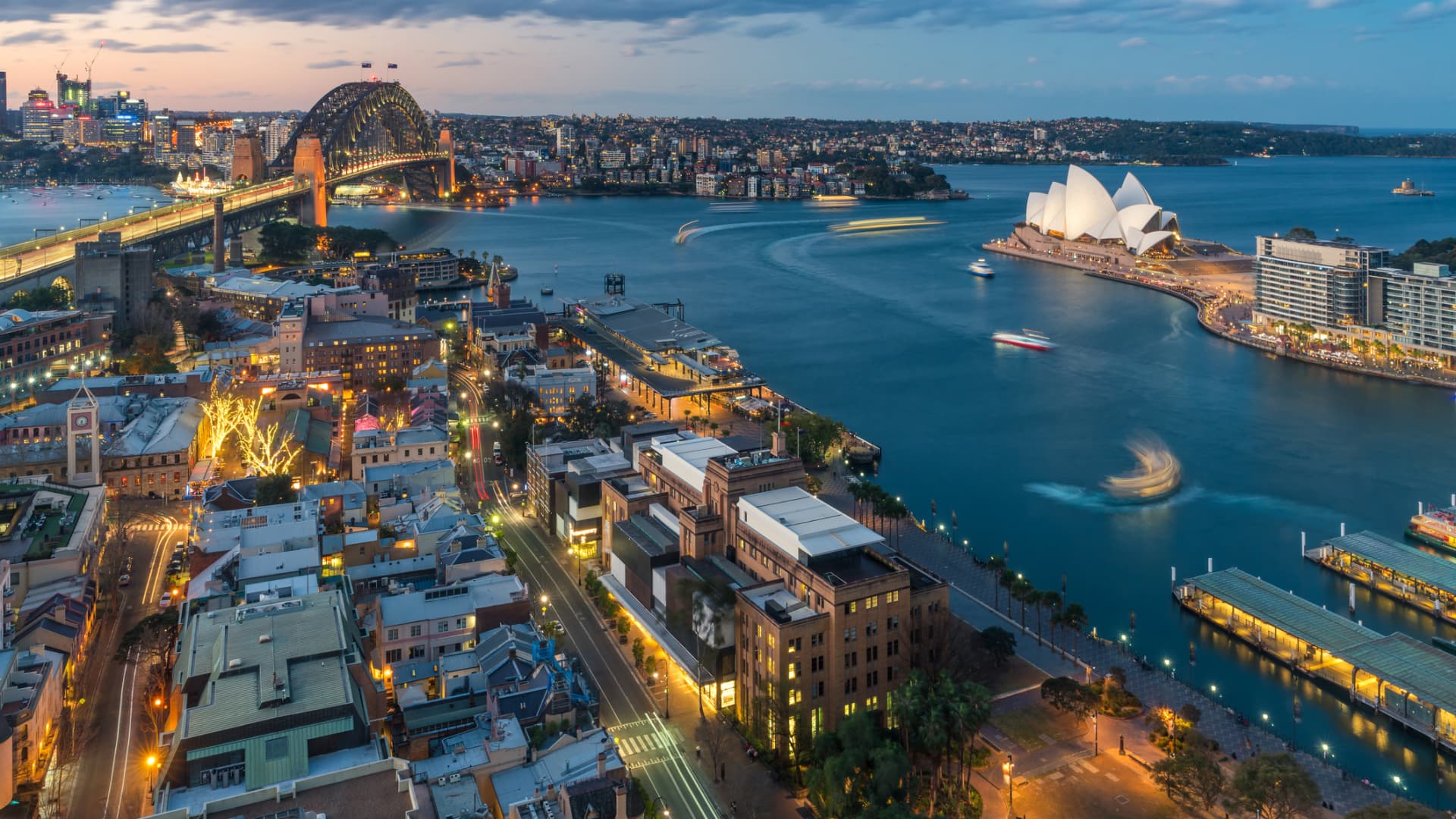

Sydney’s iconic skyline, illuminated dramatically against the night sky, serves as a backdrop to notable shifts in the financial landscape of Australia and beyond. Following Prime Minister Anthony Albanese’s historic reelection, marking the first time in 21 years an Australian leader has secured a second consecutive term, the country’s markets experienced a downturn. This win suggests a public preference for stability as global economic uncertainties loom.
On Monday, the S&P/ASX 200 fell by 0.47%, snapping a bullish streak that had driven the index to its highest point since late February. This decline underscores the market’s cautious response to political continuity amid a challenging macroeconomic environment. Accompanying this shift, the Australian dollar strengthened against its U.S. counterpart, appreciating by 0.45% to trade at 0.6471.
The ripple effects of these developments extended across regional currencies. The offshore Chinese yuan climbed 0.30% against the U.S. dollar, reaching its strongest valuation since November 2024, while the New Taiwanese dollar surged nearly 3% to 29.795, a peak not seen in over two years. However, Taiwan’s Taiex index dipped 0.31%, reflecting volatile market conditions.
With major Asian financial hubs like Japan, South Korea, Hong Kong, and China closed for public holidays, the focus shifted to ongoing market activity elsewhere. Notably, oil prices plummeted following OPEC+’s decision to increase production for a second consecutive month. Brent crude futures fell 3.31% to $59.26 per barrel, while West Texas Intermediate crude decreased 3.59% to $56.20, reflecting supply-side pressures on global energy markets.
In the United States, market sentiment appeared mixed. Although futures dipped slightly after a robust upward streak on Wall Street, the traction gained in previous sessions held. Last Friday, the S&P 500 surged 1.47% to 5,686.67, marking nine consecutive days of growth—its longest run since 2004. This recovery from losses earlier in April, when former President Donald Trump announced retaliatory tariffs, highlights a rebound in investor confidence. The Dow Jones Industrial Average leaped 564.47 points to close at 41,317.43, and the Nasdaq Composite rose 1.51% to 17,977.73, adding momentum to this upward trend.
As markets recalibrate in response to geopolitical and economic signals, including shifts in political leadership and oil production policies, financial analysts are closely monitoring these fluctuations. The narrative of continuity versus change, seen starkly in Australia’s election results and OPEC+’s production stance, continues to influence global market dynamics.
This nuanced landscape poses both opportunities and challenges for investors seeking stability and growth. Whether navigating currency fluctuations or energy price shifts, stakeholders remain attentive to the interplay of political decisions and market movements shaping the future economic trajectory.
Original Source: https://www.cnbc.com/2025/05/05/asia-markets-live-australia-markets-set-to-rally.html
Category :
Tags:
Publish Date: 2025-05-05 07:21:00