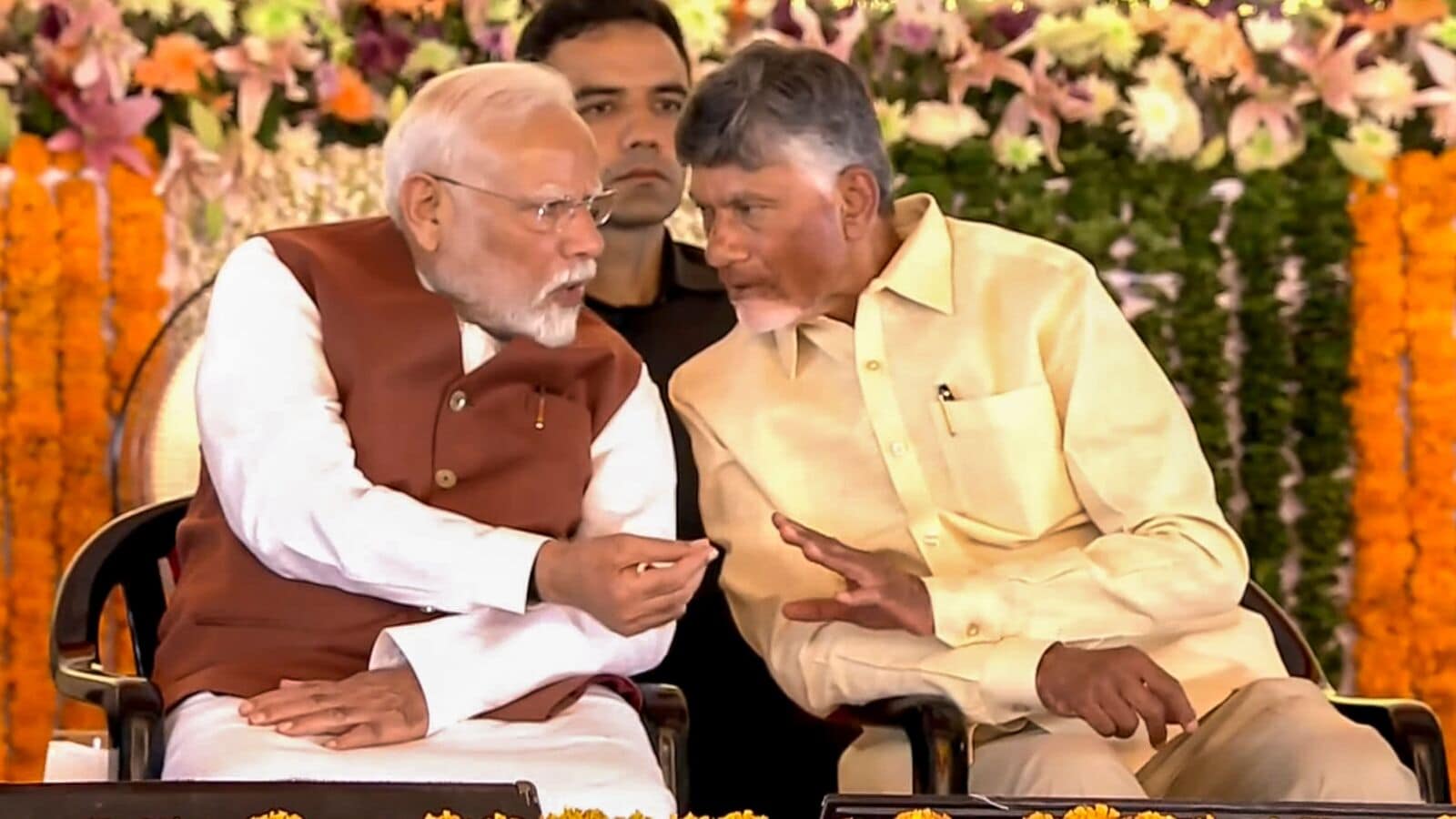

Prime Minister Narendra Modi has relaunched the construction of Amaravati, the long-anticipated capital city of Andhra Pradesh, on May 2. The restart comes with the foundation stone laid for multiple projects across the state, totaling ₹57,962 crore in investments. Central to these endeavors are the construction of the five towers of the Amaravati Government Complex, the High Court, and the Legislative Assembly Building. The initiative signals a renewed ambition to establish Amaravati as a symbol of “Swarna Andhra,” a prosperous Andhra Pradesh, aligning with Modi’s vision of a “Viksit Bharat” or developed India.
This marks a significant shift as Modi initially laid the foundation for Amaravati in October 2015 during his first term as Prime Minister. Under the guidance of then-Chief Minister Chandrababu Naidu and the TDP government, development commenced but halted in 2019 when the YSR Congress Party, led by YS Jagan Mohan Reddy, took power. Reddy proposed a tri-capital model, putting Amaravati’s progress in limbo. However, with the TDP regaining power in June of the previous year, Naidu’s enduring dream sees fresh momentum amid ongoing political and legal challenges.
During his recent visit, Modi inaugurated projects worth ₹58,000 crore, including infrastructure developments valued at ₹49,000 crore in Amaravati. These cover the Andhra Pradesh Legislative Assembly, Secretariat, High Court, and residences for judicial officers. Additionally, foundations were set for the DRDO Missile Testing Centre at ₹1,459 crore and Unity Mall in Visakhapatnam at ₹100 crore. The Guntakal-Mallappa gate rail overbridge and six new National Highway projects, amounting to ₹3,176 crore, are also part of this comprehensive development plan.
Amaravati’s journey began in 2014 following Andhra Pradesh’s bifurcation, with Hyderabad becoming Telangana’s capital. Amid political shifts, the project seemed enigmatic, facing criticism, stalled constructions, and allegations of land scams. Yet, the dream persisted, with initial costs in 2015 estimated at ₹27,097 crore, rising to ₹64,721 crore by 2025. Notably, Reddy, as the then opposition leader, supported the Amaravati concept but later criticized the large-scale land acquisition for its development.
When in power, Reddy proposed three capitals—legislative in Amaravati, executive in Visakhapatnam, and judicial in Kurnool—arguing financial constraints. This idea faced opposition, leading to the repeal of the Three Capitals Act in March 2022, yet Reddy remained committed to the vision.
The period from 2019 to 2014 saw Amaravati become a “Ghost Capital” as construction was frozen, with abandoned plots and partially built structures highlighting the stagnation. Farmers staged protests, and the project hit further roadblocks due to lapses in international partnerships. In 2023, the Comptroller and Auditor General’s report questioned financial mismanagement. By 2019, ₹15,000 crore had been spent without visible advancement.
The Andhra Pradesh High Court ruled on March 5, 2022, against arbitrary capital relocation, setting a construction deadline, prompting the state to seek recourse in the Supreme Court. With the 2024 political tide favoring the TDP allied with BJP and Jana Sena, Naidu’s capital dream sees a tangible resurrection.
As Amaravati’s revival progresses, it embodies a symbol of aspirations for both regional development and national integration under Modi’s leadership. The stakes are considerable, involving a decade-long vision entwined with economic, political, and social narratives, making it a focal point for Andhra Pradesh’s future.
Original Source: https://www.livemint.com/news/india/the-curious-case-of-amravati-the-launch-relaunch-of-cm-naidus-capital-dream-by-pm-modi-explained-11746188667383.html
Category :
Tags:
Publish Date: 2025-05-02 18:58:00