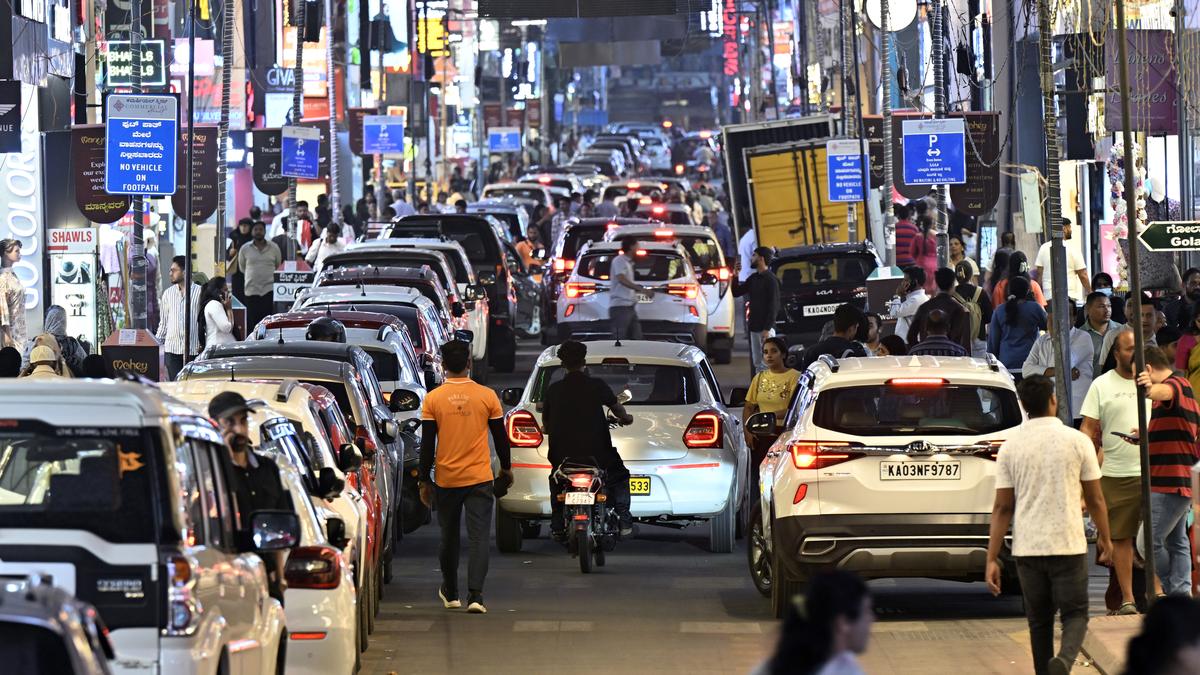

Bengaluru, renowned as India’s tech hub, faces a growing challenge: parking. Sudarshan Yadav, a real estate broker from J.P. Nagar, dreads his Saturday evening trips to Church Street due to the notorious parking difficulties. He often spends over 10 minutes searching and sometimes parks half a kilometer away. Similarly, software engineer Prajwal Kumar struggles with minimal parking spaces at metro stations, often driving to work as a result.
The city’s parking woes symbolize deeper urban issues. Rapid, unplanned growth has led to an overwhelming surge in vehicles, swelling to over 1.23 crore registered in the city, 70% of which are two-wheelers. The middle-class affluence has increased vehicle ownership, but parking infrastructure has lagged, resulting in congested streets.
Bengaluru’s transformation has turned residential areas into commercial hubs without corresponding infrastructure upgrades. Narrow roads, particularly in places like Indiranagar and J.P. Nagar, struggle with illegal parking due to unchecked commercialization. Sneha Nandihal from I Change Indiranagar points out that trade licenses are issued without proper inspections, exacerbating the parking crisis.
Public transport in Bengaluru is underdeveloped and poorly integrated, with limited metro connectivity and challenging last-mile connections. The situation worsened when the Bengaluru Traffic Police (BTP) halted vehicle towing in 2022 due to public backlash. Home Minister G. Parameshwara hinted at reintroducing towing on high-density corridors, but no formal proposal exists yet.
The Directorate of Urban Land Transport (DULT) introduced Parking Policy 2.0 in 2012, promoting demand-based paid parking to reduce private vehicle use and promote public transport. The policy calls for organized, monitored, and privately managed parking systems, yet it remains mostly unimplemented.
Initiatives like paid parking zones in commercial areas and multi-level parking (MLP) facilities have seen mixed results. BBMP, the city’s civic body, faces challenges due to inadequate enforcement and backlash from businesses fearing reduced footfall. The BBMP’s app-based parking system in Indiranagar was suspended due to user dissatisfaction.
Despite implementing a few off-street parking projects, most facilities remain underutilized due to continued on-street parking. Transportation expert Ashish Verma from IISc emphasizes the need for a demand-management approach over supply expansion, advocating for incentivizing public transport.
Bengaluru’s evolving public transport is expected to cover 368 km with over 230 stations by 2030, providing potential relief if well-integrated with metropolitan buses. However, Srinivas Alavilli from World Resources Institute – India, suggests park and ride solutions may not suffice due to the city’s high vehicle density. He stresses the necessity for robust last-mile connectivity to shift commuters from private to public transport.
Until policy enforcement and public transport improvements are effectively implemented, Bengaluru’s parking crisis is likely to persist, posing a significant challenge to the city’s infrastructure and daily life.
Original Source: https://www.thehindu.com/news/cities/bangalore/fixing-bengalurus-parking-problem-the-need-to-bell-the-cat/article69482094.ece
Category : Bengaluru
Tags:
Publish Date: 2025-05-02 07:48:00