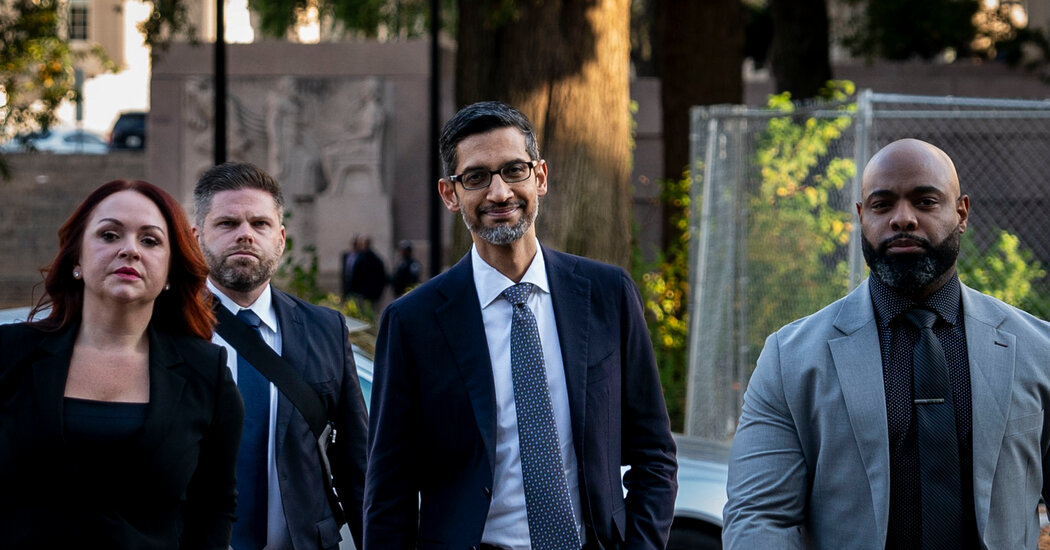

In a pivotal court hearing, Google CEO Sundar Pichai defended the tech giant against proposals from the U.S. government aimed at dismantling its alleged monopoly in online search. The government proposes measures that could include requiring Google to sell its popular Chrome browser and share data with competitors. These actions follow a ruling by Judge Amit P. Mehta of the U.S. District Court for the District of Columbia, which determined that Google unlawfully maintained its search dominance. The proceedings at this landmark hearing could significantly affect the competitive landscape in Silicon Valley, particularly within the fast-evolving realm of artificial intelligence-powered products.
During his testimony, Pichai argued that the proposed remedies would stifle Google’s future investments in research and development. “The combination of all the remedies, I think, makes it unviable to invest in the R&D the way we have for the past three decades,” he stated. Pichai emphasized the detrimental impact these changes could have on innovation and Google’s ability to continue advancing its search technology.
This case marks a significant test of the U.S. government’s efforts to curb the power of dominant tech companies in sectors spanning commerce, communications, and information. Another pertinent case includes the Federal Trade Commission’s challenge against Meta, concerning its acquisitions of Instagram and WhatsApp, alongside pending antitrust lawsuits targeting Apple and Amazon. The Justice Department initiated the lawsuit against Google during President Trump’s tenure in 2020, arguing that Google solidified its search engine monopoly by paying firms like Apple and Mozilla to feature its engine as the default option, reportedly spending $26.3 billion on such deals in 2021.
Judge Mehta previously ruled against Google, and the current hearings aim to establish the appropriate corrective measures. The Justice Department advocates for radical steps, such as divesting Chrome due to its automatic link to Google’s search engine, and mandating that Google share its search result data with other competitors, enabling them to access user search trends and click-through data.
In response, Pichai described the data-sharing proposal as equivalent to a “de facto divestiture” of Google’s proprietary technology, allowing competitors to dissect and replicate critical parts of its technology stack. Google counters with a less severe proposal, suggesting it retains the right to pay for search prominence but opens certain agreements to annual renegotiation and grants device manufacturers greater choice over pre-installed Google apps.
The case highlights a broader regulatory push within the tech sector, scrutinizing the immense influence of major players like Google. The unfolding courtroom drama serves as a precursor to potential shifts that could redefine competitive strategies within internet technology industries. The outcome could potentially recalibrate power dynamics, spurring competitors’ growth while challenging Google’s market hold.
Sundar Pichai’s testimony underscores the tension between fostering open competition and protecting corporate innovation. As the hearing progresses, it remains to be seen how these proposed changes might reshape the future of digital technology and the regulatory frameworks governing it.
Original Source: https://www.nytimes.com/2025/04/30/technology/google-ceo-antitrust-trial.html
Category : Search Engines,Computers and the Internet,Decisions and Verdicts,Artificial Intelligence,Mergers, Acquisitions and Divestitures,Regulation and Deregulation of Industry,Chrome (Browser),Justice Department,Google Inc
Tags:
Publish Date: 2025-04-30 23:26:00