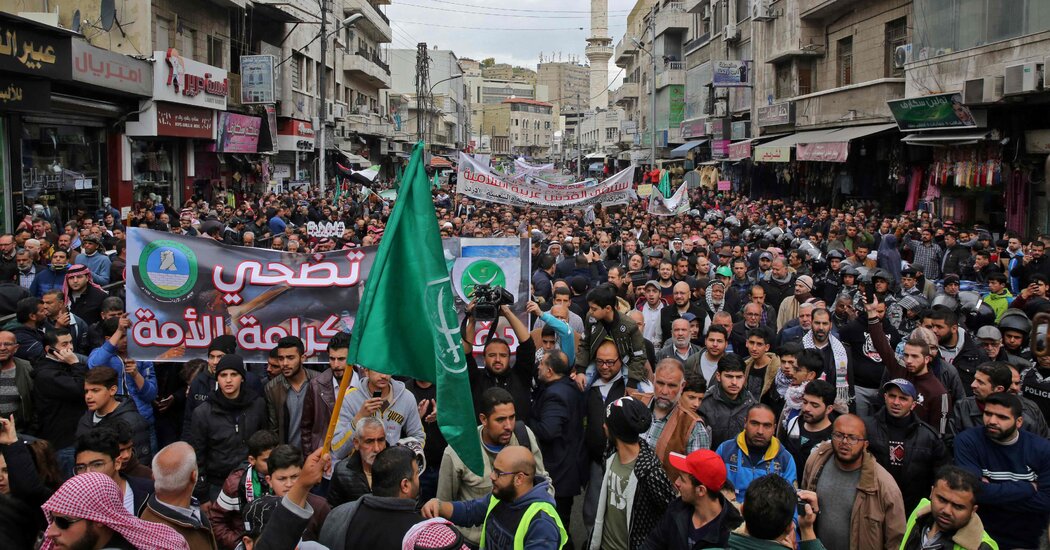
Unveiling the Controversy: The Shocking Truth Behind Jordan’s Bold Ban on the Muslim Brotherhood

In a decisive move against the Muslim Brotherhood, Jordan has imposed a sweeping ban on the organization, signaling significant tensions between the kingdom and its largest opposition party, the Islamic Action Front. This action comes on the heels of Jordanian authorities arresting 16 individuals involved in what was described as a serious threat to national security, complete with incendiary hardware and plans for drones. Interior Minister Mazin Al Farrayeh indicated that elements associated with the Muslim Brotherhood were implicated in these activities intended to destabilize Jordan.
The Muslim Brotherhood, an influential Sunni Islamist movement founded in Egypt in 1928 by Hassan al-Banna, has a history marked by its conflicting ideologies and widespread influence across the Middle East. Initially founded to counter colonialism and bolster Islamic values, the Brotherhood has often been criticized for its ambiguous stance on governance. Despite officially denouncing violence, disillusionment within its ranks has driven some members towards more extreme entities like Al Qaeda.
In Jordan, this is not the first clash between the government and the Brotherhood. Authorities previously shut down the Brotherhood’s headquarters in Amman in 2016 and initiated efforts to disband the organization in 2020, though the Islamic Action Front continued its political activities. Analysts suggest that the current ban might be influenced by broader geopolitical factors, including global reactions to Hamas, which shares historical ties with the Brotherhood. Jon B. Alterman of the Center for Strategic and International Studies noted that recent events in Gaza have heightened domestic concerns for Jordan, potentially reducing the government’s tolerance for political opposition due to fears of civil unrest.
Jordan’s actions resonate with a broader international narrative. The Muslim Brotherhood, which once thrived on ideals of democratic participation, is facing increasing opposition, especially from authoritarian regimes. The turbulence was notably exemplified in Egypt, where the Brotherhood’s rise to power was short-lived. Mohamed Morsi, Egypt’s first democratically elected president and a former Brotherhood leader, was ousted by the military in 2013, and the group was subsequently banned.
The unfolding situation poses critical questions for the future of the Islamic Action Front, as the ramifications of the ban on its operations become clearer. On Wednesday, security forces surrounded the party’s headquarters in Amman. Wael Saqqa, the secretary-general of the group, acknowledged their compliance with the authorities during this unexpected scrutiny. However, like the broader Brotherhood, the Islamic Action Front has yet to publicly respond to Jordan’s crackdown.
The international community continues to monitor these developments. Historically, Western countries have had contentious relationships with the Brotherhood; during Donald Trump’s presidency, the U.S. considered designating it a terrorist organization, a move that could have triggered significant geopolitical and economic ramifications. In the volatile landscape of Middle East politics, Jordan’s latest decree adds another layer of complexity, aligning it with countries that view the Brotherhood as a threat while highlighting the enduring interplay between domestic governance and international diplomacy.
Jordan’s growing Palestinian population adds another dimension of complexity, driving local discontent over regional conflicts such as the Gaza war, which influences domestic policy decisions. As these dynamics unfold, the balance between maintaining internal stability and navigating international relations remains delicate for the Jordanian government, underscoring the far-reaching implications of its recent actions against the Muslim Brotherhood.
Original Source: https://www.nytimes.com/2025/04/23/world/middleeast/muslim-brotherhood-explainer.html
Category : Jordan,Muslim Brotherhood (Egypt),Bombs and Explosives,Muslims and Islam,Politics and Government,International Relations,United States International Relations,Terrorism,Middle East,Israel-Gaza War (2023- ),Israel,Gaza Strip,Egypt,Iran,Palestinians,Drones (Pilotless Planes)
Tags:
Publish Date: 2025-04-24 05:05:00