Unveiling the Charming U.S. Architecture Pavilion: Inspiring Lessons from the Iconic American Porch

The United States Pavilion at the Venice Architecture Biennale is spotlighting the potential of architecture and design to bridge America’s growing societal divides. Opening to the public on May 10, this year’s exhibition, titled “Porch: An Architecture of Generosity,” explores how the quintessential American porch—a space connecting public and private life—can inspire unity and dialogue. Susan Chin of DesignConnects, one of the exhibit’s commissioners, emphasizes that the pavilion aims to highlight “the value of being together,” using the architectural metaphor of a porch to foster community ties.
Peter B. MacKeith, dean of the Fay Jones School of Architecture and Design at the University of Arkansas and lead commissioner for the project, describes the porch as a “platform for civic engagement and community building.” The exhibition will feature 54 diverse designs from across the U.S. that reinterpret the concept of a porch. Housed in cabinet-like “porch windows,” these models and artifacts invite visitors to engage with them on an experiential level.
The pavilion broadens the traditional idea of a porch, including diverse interpretations such as Brooklyn stoops, Hawaiian lanais, and public plazas. A notable example is the transformation of the Oakland Museum of California by Mark Cavagnero Associates in collaboration with Hood Design Studio. By creating open spaces, they turn the once-intimidating structure into a welcoming community hub. “These are places that scream enter, scream welcome, scream inviting,” said founder Mark Cavagnero.
Los Angeles-based nonprofit Friends of Residential Treasures: LA (FORT:LA) examines “porchness” in multifamily apartments, highlighting communal areas like walkways and courtyards. In Fayetteville, Arkansas, modus studio has designed a gathering space for the Ozark Natural Foods Co-Op, while Duvall Decker has incorporated porches throughout the Bennie G. Thompson Academic and Civil Rights Research Center at Tougaloo College, encouraging student interaction.
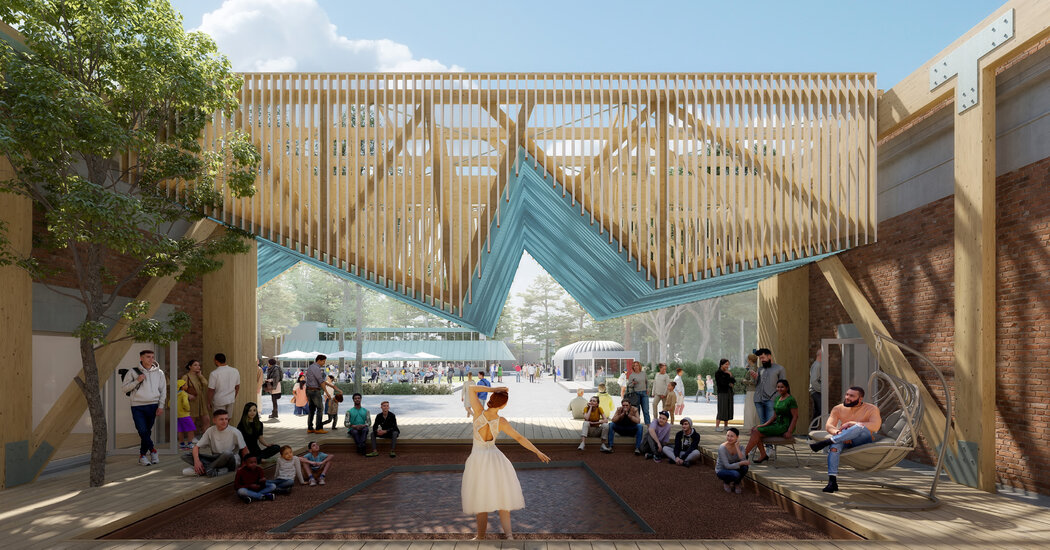
The U.S. Pavilion itself is a Palladian-style structure, designed in 1930, and will feature an innovative porch by a team including Marlon Blackwell Architects and others. Visitors are invited to a layered, terrain-inspired platform within the pavilion’s courtyard, highlighted by a blue-painted canopy typical of Southern porches. This space aims to host discussions and performances, fostering spontaneous gatherings.
Under the Biden administration, the U.S. State Department has endorsed this initiative with a $375,000 grant. Total exhibition costs reach $1.75 million, supported by entities like the University of Arkansas and the Alice L. Walton Foundation. Despite previous funding cuts to cultural programs by the Trump administration, the State Department remains committed to supporting American participation in the international biennale.
Carlo Ratti, chief curator of the biennale, views “Porch” as integral to addressing the challenges of the built environment and promoting face-to-face interactions that digital spaces often lack. This exhibition also highlights the burgeoning design scene in Northwest Arkansas, a region becoming known for groundbreaking architecture due to initiatives like the Walton Family Foundation’s Design Excellence Program.
By focusing on the porch, the U.S. Pavilion seeks to showcase the importance of open, communal spaces in fostering inclusivity and unity. As Cavagnero puts it, “The more we can make ourselves and our buildings open and expansive, the better we can bring the community into our civic life.”
Original Source: https://www.nytimes.com/2025/04/11/arts/dance/us-pavilion-architecture-biennale.html
Category : Architecture,Porches, Patios and Decks,Venice Architecture Biennale,Crystal Bridges Museum of American Art,Arkansas,Venice (Italy)
Tags:
Publish Date: 2025-04-11 23:28:00