
Researchers have achieved the most precise measurement to date of a neutrino’s mass, inching closer to revealing discrepancies within the Standard Model of physics. Published in the journal Science, this latest finding establishes a new upper limit for the neutrino’s mass without pinpointing its exact value. Despite this ambiguity, the study represents a significant step toward understanding the anomalies within the Standard Model, which currently posits that these elusive particles should be massless.
Neutrinos are abundant, ghostly particles generated whenever atomic nuclei fuse or split. They pose a challenge to detection due to their lack of electric charge. Interestingly, neutrinos exist in three types, or “flavors,” and can morph between these states as they traverse space and time, a phenomenon that earned a Nobel Prize in Physics in 2015. This ability implies they possess a minuscule mass, which contradicts their extremely light nature—a mystery still confounding physicists.
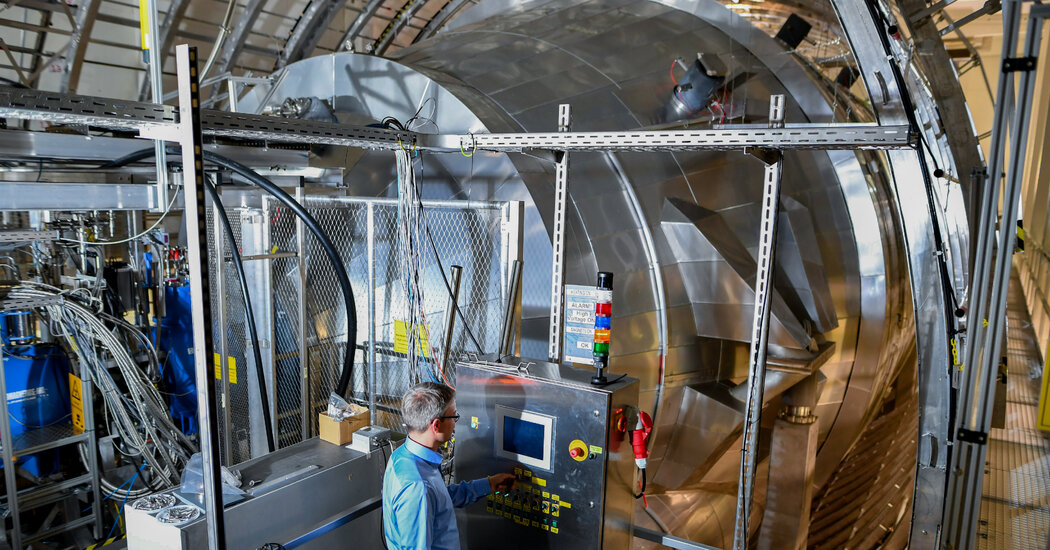
Led by Alexey Lokhov at the Karlsruhe Institute of Technology in Germany, the research team employed the Karlsruhe Tritium Neutrino (KATRIN) experiment to refine the neutrino’s mass estimation. KATRIN uses a 230-foot-long setup wherein unstable tritium decays into helium. This decay process also releases an antineutrino, theoretically mirroring a neutrino’s mass. Though neutrinos are undetectable directly, the KATRIN experiment recorded 36 million electrons over 259 days from decaying tritium, facilitating an indirect assessment of the antineutrino’s mass. The results set this upper mass limit at just 0.45 electronvolts—over a million times lighter than an electron.
This measurement, focused on one neutrino flavor, marks a significant improvement from the previous KATRIN-established limit of 0.8 electronvolts in 2022. Critically acclaimed by experts like Elise Novitski from the University of Washington, the experiment’s precision reflects the meticulous efforts behind this advance.
Phycisist John Wilkerson from the University of North Carolina, an author of the study, highlights that determining one neutrino flavor’s mass facilitates estimating the others. He underscores neutrinos’ potential role in unraveling cosmic mysteries, including galaxy formation and expansion post-Big Bang. “We’re looking at trying to understand why we are here,” Wilkerson remarked, noting that neutrinos could hold the key.
KATRIN aims to further tighten the neutrino mass boundary using 1,000 days of data expected by the year’s end. This extended study promises even greater precision as more electrons undergo measurement. Meanwhile, additional experiments like Project 8 in Seattle and the Deep Underground Neutrino Experiment in the Midwest, offer alternative pathways to understand neutrinos better.
While astronomers offer their own maximum mass estimates for these particles based on cosmic observations, discrepancies persist between these and lab-based particle physics measurements. Wilkerson suggests these mismatches might indicate undiscovered physics beyond the Standard Model, hinting at an exciting frontier in scientific exploration.
This convergence of research efforts reflects an ongoing quest to solve one of physics’ enduring riddles. As the scientific community continues to probe neutrinos, the hope is to unveil aspects of the universe yet unexplored, potentially rewriting fundamental theories about matter and energy.
Original Source: https://www.nytimes.com/2025/04/10/science/neutrinos-mass-physics.html
Category : Neutrinos,Physics,Research,Science (Journal)
Tags:
Publish Date: 2025-04-10 23:39:00