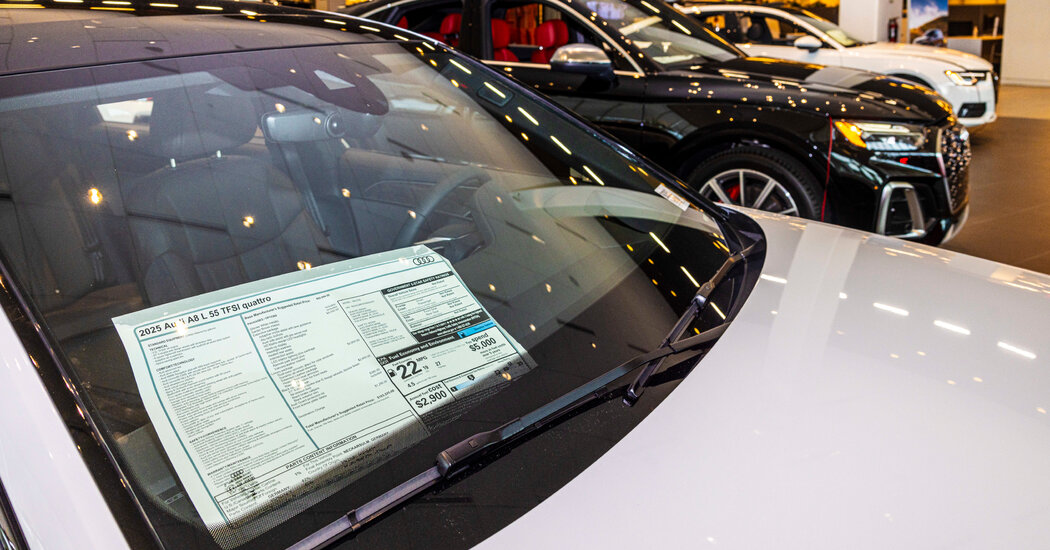

In a move stirring significant global economic reaction, President Trump’s imposed tariffs on imported vehicles have officially taken effect. This policy introduces a 25% duty on cars assembled outside the United States, a measure he argues will drive investments and job creation domestically. Analysts, however, caution that this could elevate new car prices by thousands, potentially reshaping the automobile industry landscape.
Starting May 3, the tariff will extend to imported auto parts, escalating costs for vehicles assembled in the U.S. and affecting auto repair expenses. While a partial exemption exists for cars built in Mexico or Canada under specific free trade agreements, most automakers will still face increased production costs. For example, General Motors, maker of the Chevrolet Equinox EV which combines U.S.-made battery packs with components from Mexico, will only incur tariffs on the foreign-made elements.
The ripple effects are expected to impact U.S. manufacturing plants significantly. Vehicles produced in Michigan, Tennessee, Ohio, and other states typically incorporate foreign-made parts, often accounting for over half their cost. Data from the National Highway Traffic Safety Administration reveals that a staggering 90% of the value of certain Mercedes-Benz vehicles manufactured in Alabama stems from imported European engines and transmissions.
Nevertheless, the tariff’s influence will vary across different vehicles. Models like the Tesla Model Y, produced in Texas and California, and the Honda Passport, assembled in Alabama, will see a lesser impact due to their high percentage of U.S.-made components. Conversely, vehicles manufactured entirely overseas, such as Japan’s Toyota Prius or Germany’s Porsche sports cars, will bear the brunt of these duties.
The effects won’t be limited to new car buyers. Consumers will likely encounter higher prices for essential auto parts, including tires, brake pads, and oil filters. Michael Holmes, co-chief executive of Virginia Tire and Auto, a service chain, indicated that while his company might initially absorb some increased costs, this approach is not long-term viable. “It’s magical thinking to think businesses won’t pass this on,” Holmes noted.
As new car prices rise, the market for used vehicles may see heightened demand, inevitably driving up their costs. Experts predict that this shift could also lead to increased insurance premiums as the expense of repairs escalates.
International trade dynamics, particularly in the automotive sector, are poised for further shifts as these tariffs take root, impacting not only U.S. politics and consumer expenditures but also the broader perspectives on global manufacturing and supply chain practices. As stakeholders across the automobile industry brace for these changes, the long-term implications on international trade and consumer behavior remain under close scrutiny.
Original Source: https://www.nytimes.com/2025/04/03/business/trump-auto-tariffs-car-prices.html
Category : Automobiles,Customs (Tariff),Factories and Manufacturing,Trump, Donald J,International Trade and World Market,Electric and Hybrid Vehicles,United States Politics and Government,Prices (Fares, Fees and Rates),General Motors,Tesla Motors Inc,Canada,United States,Mexico,Germany,Japan
Tags:
Publish Date: 2025-04-04 22:05:00