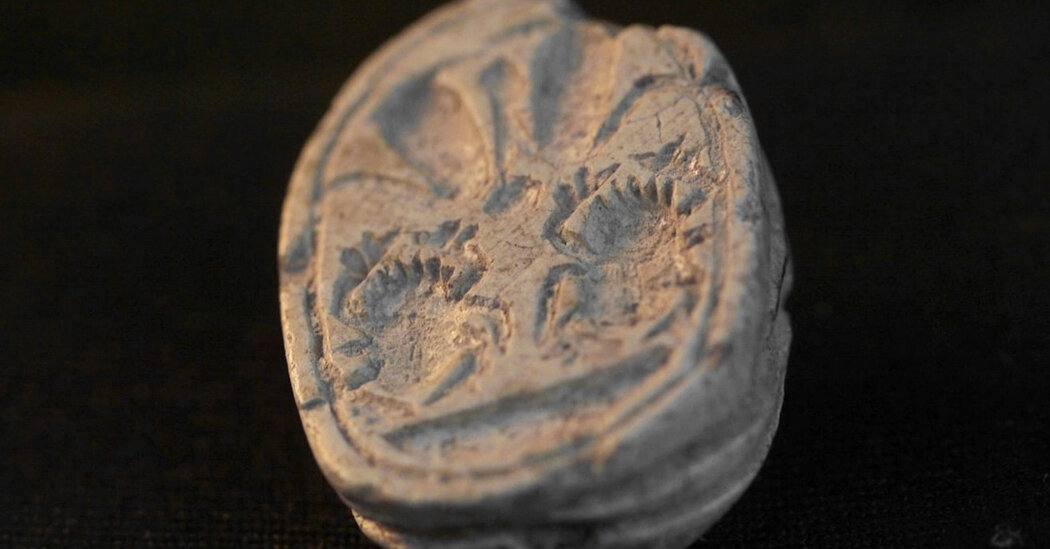

A serendipitous archaeological discovery has recently enchanted the world, stemming not from seasoned professionals but from a curious 3½-year-old named Ziv Nitzan. This young explorer was hiking with her family near Tel Azekah, about 25 miles from Jerusalem, when she stumbled upon an ancient treasure — a 3,800-year-old Egyptian amulet. Intrigued by what she initially thought were “teeth” on a small rock, Ziv’s curiosity led her to uncover a remarkable artifact belonging to the Bronze Age.
The Israel Antiquities Authority confirmed the amulet’s authenticity, identifying it as a scarab, a type of engraved talisman prevalent in ancient Egypt. Scarabs were often used as symbols of rebirth, given the dung beetle’s life cycle, which aligns with their cultural significance. This lucky find has since been linked to the Canaanites, a Semitic people who lived around 1800 B.C., known for their fascination with Egyptian culture and their tendency to import or replicate Egyptian luxuries and styles, including amulets.
This isn’t the first time young adventurers have discovered significant artifacts in Israel, a hotspot of historical finds due to its rich past. Recent instances include a 13-year-old who uncovered a Roman-era ring near Haifa and a 7-year-old who found a 3,400-year-old carving in the Beit She’an Valley. However, Ziv’s find is particularly notable as she is the youngest known child to discover such an ancient artifact in the region.
Dr. Oded Lipschits, a professor of Jewish history at Tel Aviv University, sheds light on how such ancient items surface in modern times. His explanation traces back to 1898 when British archaeologists excavated Tel Azekah, uncovering various historical structures and artifacts. Afterward, the site was refilled at the request of the landowner, embedding modern and ancient layers together. As a result, ancient relics now lie close to the surface, making it possible for curious young eyes and nimble hands to spot them.
While the scarab Ziv discovered isn’t unique in its kind — archaeologists like Dr. Lipschits’s team have unearthed many similar items, some of finer craftsmanship—the significance lies in its timely discovery and preservation. The Nitzan family’s decision to pass the amulet to the Israel Antiquities Authority ensures its preservation and the opportunity for public appreciation. “If she put it in her pocket and kept it, we wouldn’t know about it,” Yoli Schwartz, spokesperson for the authority, remarked. The organization expressed their gratitude with a certificate of appreciation for Ziv, acknowledging her act as one of “good citizenship.”
The scarab is set to be featured in an upcoming exhibition at the Jay and Jeanie Schottenstein National Campus for the Archaeology of Israel in Jerusalem, sharing space with other relics from Canaanite and Egyptian histories. In this way, Ziv’s remarkable find contributes not just to archaeological study but also to the broader narrative of human history, ensuring that a new generation can learn from and be inspired by these ancient cultures.
Original Source: https://www.nytimes.com/2025/04/03/world/middleeast/child-ancient-discovery-israel.html
Category : Archaeology and Anthropology,Youth,Israel Antiquities Authority,Israel,Egypt
Tags:
Publish Date: 2025-04-03 19:54:00