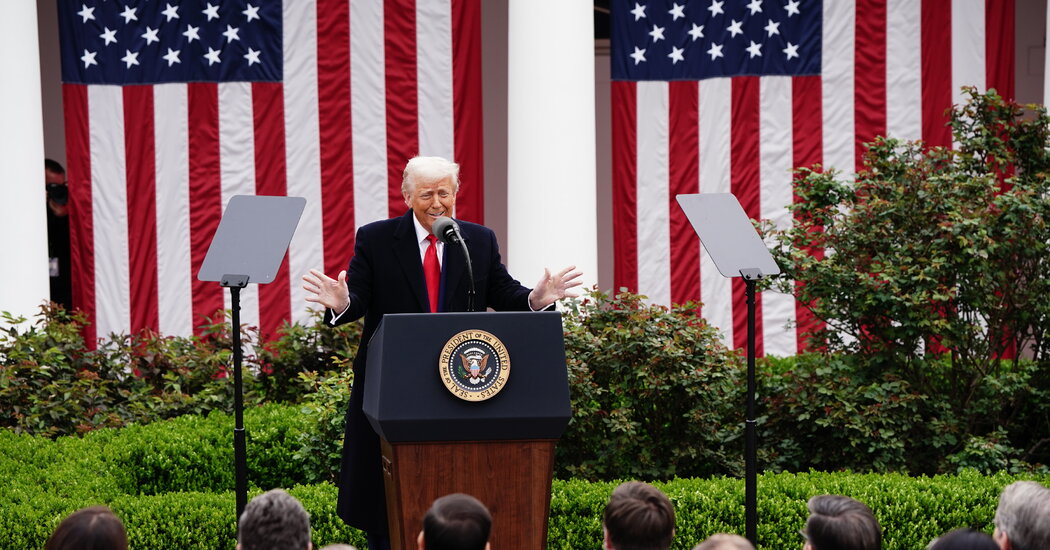

President Donald Trump’s announcement of sweeping tariffs on numerous U.S. trading partners marks a significant shift in international trade relations, potentially reshaping the global economic landscape. Revealed as a “reciprocal” tariff strategy, the new policy imposes substantial levies on various nations, stirring unease among America’s allies. The European Union, facing a formidable 20 percent tariff, and China, burdened with an additional 34 percent levy, are among the major economies most affected.
Eswar Prasad, a professor at the Dyson School at Cornell University, underscored the gravity of the situation by stating, “The scope and size of tariffs are both substantial and confirm the worst fears of the proponents of free trade. Trump is setting off a new era of protectionism that will reverberate worldwide.” While Canada and Mexico, key U.S. trading partners, are exempt from additional new tariffs, they are still subject to previously announced levies on vehicles, vehicle parts, steel, aluminum, and other goods outside the U.S.-Mexico-Canada Agreement provisions.
The United States’ new tariff strategy includes a baseline 10 percent levy on all countries, excluding Canada and Mexico, with additional tariffs based on perceived unfair barriers and tariffs imposed on U.S. exports. Asian nations such as Japan, India, Vietnam, Cambodia, Bangladesh, and Sri Lanka are set to experience steep tariffs, significantly impacting their economies. Data from Exiger, a data analytics firm, indicates China’s exports could face $149 billion in additional tariffs, while Vietnamese goods could see $63 billion in new levies.
Global reactions have been varied, with European allies voicing plans for retaliation. In response to prior steel and aluminum tariffs, Europe is considering countermeasures that could affect U.S. technology companies. Prime Minister Anthony Albanese of Australia criticized the 10 percent tariff imposed on his country as “having no basis in logic,” yet he confirmed Australia would refrain from immediate retaliation.
In Mexico and Canada, while there is relief over avoiding further tariffs, caution remains. Luis de la Calle, a prominent Mexican trade economist, called the avoidance “good news” but noted the persistent effects of existing tariffs. Prime Minister Mark Carney of Canada highlighted ongoing tariffs related to curbing the flow of fentanyl into the U.S., asserting Canada’s commitment to countermeasures.
The global trade community is grappling with the fundamental objectives of Trump’s tariff strategy. If the aim is to create a fairer trading system, there might be room for negotiation. However, if revenue generation is the priority, finding common ground could be challenging. Amid uncertainty, nations are preparing for both negotiations and potential escalation. Europe stands ready with retaliatory tariffs targeting American products but waits to understand the full implications of the new tariffs.
Additionally, geopolitical issues like military spending and tech regulation are becoming entwined with trade disputes. The U.S. desires greater EU defense contributions and looser tech regulations, adding another layer of complexity. Mujtaba Rahman of the Eurasia Group noted that European leaders are cautious but prepared to assert economic strength to negotiate effectively.
This intricate web of economic and political factors underscores the potential for prolonged trade tensions, with the global economic order hanging in the balance. As nations navigate these changes, the world watches to see how partnerships and international trade dynamics evolve.
Original Source: https://www.nytimes.com/2025/04/02/world/europe/trump-tariffs-reciprocal-reaction-trade-war.html
Category : Customs (Tariff),Trump, Donald J,Europe,Canada,United States,China,Mexico,International Trade and World Market
Tags:
Publish Date: 2025-04-03 04:13:00