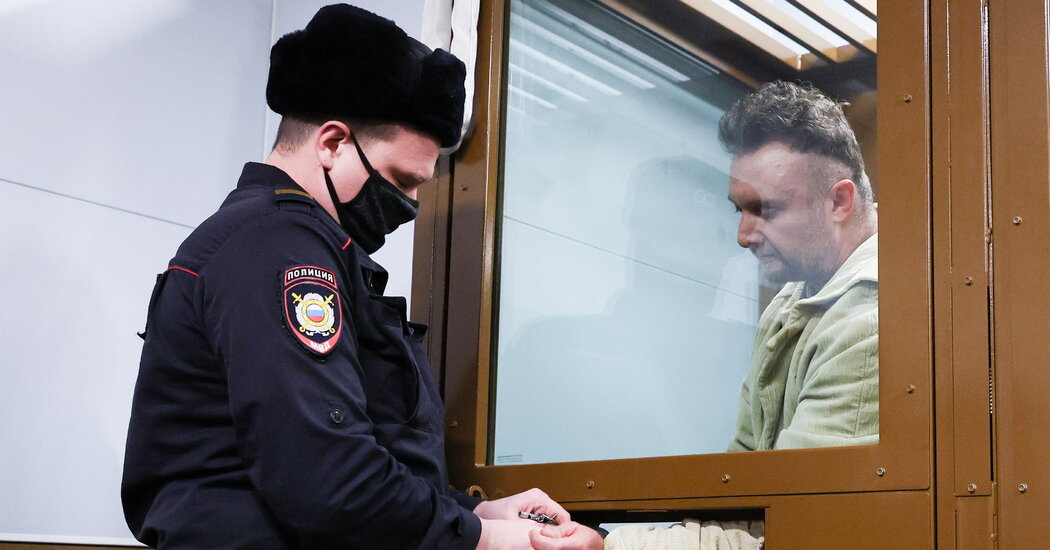

In the shadow of increasing restrictions imposed in Russia, Andrei Kotov’s travel agency, which specialized in tours for men, attracted police scrutiny under new laws curtailing gay rights. In December, officers raided Kotov’s apartment. According to a court testimony, the officers restrained him, allegedly assaulted him, and coerced him to admit that his agency catered to gay clients—an accusation he refuted. The officers reportedly said, “No trips for gays.” Shortly after, Kotov, aged 48, was discovered deceased in his cell, with prison authorities suggesting self-inflicted injuries. His lawyer, Leysan Mannapova, cited skepticism over this account since a psychological evaluation had not flagged any suicidal tendencies. The circumstances of his death remain ambiguous, with no official comment from Russian authorities.
Kotov’s tragic end underscores the intensifying crackdown on L.G.B.T.Q. rights in Russia, a campaign amplified since the Ukraine conflict began. President Vladimir Putin frames these measures as preserving “Russian traditional values.” In a significant move, the Russian Supreme Court declared the “international L.G.B.T.Q. movement” as an extremist group, inviting severe penalties for activism, ranging from six to 10 years of incarceration. This ruling has emboldened a heightened repression, with police operations targeting gay nightclubs and private gatherings.
Members of the L.G.B.T.Q. community, backed by groups like Human Rights Watch, report that the state’s focus has shifted from activists to ordinary citizens. Denis Olyenik from “Coming Out,” an aid organization for L.G.B.T.Q. individuals in Russia, observes that even non-activist social spaces now face scrutiny, signaling a widening net of repression.
Russia’s harsh policies mark a striking reversal from its past, when, after 1993 decriminalization, the country’s gay scene blossomed. However, the tides turned in 2013 when Putin enacted a law against “gay propaganda” to minors, with escalating measures since.
Kotov faced additional charges related to child sexual abuse imagery, but Mannapova says evidence was not accessible for review. These allegations further complicated an already opaque legal battle for Kotov. His mother seeks posthumous exoneration, questioning the framing of her son’s ventures as extremist.
Another emblematic incident following the 2023 court ruling involved a police raid at a Moscow club. Sergei Artyomov recounts being detained and ID’d during the raid. He subsequently sought asylum in Spain, saying, “There is no gray area anymore.”
Russia’s anti-gay drive has witnessed support from local vigilantes and state media, which decry deviations from heteronormative family models. A Telegram channel from Yakutia criticized local debauchery, leading to hefty fines for public order violations. Vigilante takedowns of L.G.B.T.Q.-friendly venues have also been documented online, with legal actions pursued against venue managers.
Surveys by Levada indicate a growing societal resistance to L.G.B.T.Q. rights, influenced by state rhetoric. Older generations remain less accepting, although youth show greater inclusivity. Yet, pervasive anti-gay narratives threaten to mold perceptions.
Amid the escalating persecution, numerous L.G.B.T.Q. Russians are leaving the country. Still, some, like 25-year-old Tahir, choose to stay, asserting, “This country is mine as much as it is for others,” despite the darkening horizon for L.G.B.T.Q. rights in their homeland.
Original Source: https://www.nytimes.com/2025/04/01/world/europe/russia-lgbtq-gay-prison-death-andrei-kotov.html
Category : Homosexuality and Bisexuality,Russian Invasion of Ukraine (2022),Discrimination,Law and Legislation,Putin, Vladimir V,Russia
Tags:
Publish Date: 2025-04-01 14:30:00