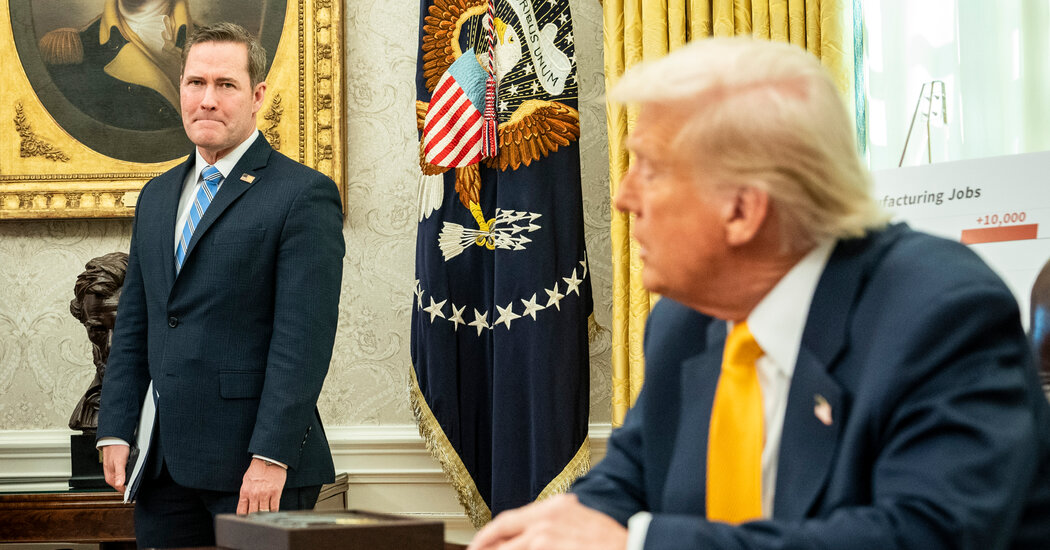

President Donald Trump found himself grappling with a difficult decision this week, weighing the fate of his national security adviser, Michael Waltz, after an embarrassing leak of a Signal chat group. The leak, resulting from Waltz accidentally adding journalist Jeffrey Goldberg, sparked concern and debate within the Trump administration regarding national security protocols and media relations. Although President Trump publicly defended Waltz by stating he is a “good man” with no reason to apologize, behind closed doors, Trump’s uncertainty was evident. He sought opinions from both inside and outside the administration, expressing dissatisfaction with the media’s portrayal of the incident.
Conflicted about taking action that might echo the chaotic staffing turnover of his first term, Trump reportedly resisted immediate dismissal. However, the crux of Trump’s concern seemed to lie not with Waltz’s carelessness, but rather the connection to Goldberg, a journalist whom Trump has openly criticized. The revelation that Waltz had Goldberg’s contact raised suspicions within the administration, compounded by a resurfaced 2016 video where Waltz criticized Trump, which was shared widely following the leak.
A meeting on Wednesday that included Vice President J.D. Vance, White House Chief of Staff Susie Wiles, and other top officials revolved around whether Waltz should continue in his role. Despite initial hesitations, by Thursday evening, Trump signaled his intent to retain Waltz, partly due to the internal support Waltz still enjoyed and partly due to a desire to avoid a repeat of the early dismissals that marked his first administration and suggested chaos. This decision seemed to underscore Trump’s preference to disregard external pressures in his second administration.
Nevertheless, some allies within the administration view Waltz skeptically. Known for his hawkish stance, Waltz’s policy approach, particularly concerning Iran, has clashed with Trump’s more diplomatic preferences, causing friction with key figures like Vance and Wiles. Further complicating matters is the photograph from a 2021 event showing Waltz and Goldberg together, contradicting Waltz’s denial of familiarity with the journalist.
Unlike Waltz, Defense Secretary Pete Hegseth appeared to face less scrutiny despite also being involved in the Signal thread that contained sensitive military operations details. Trump publicly exonerated Hegseth, reinforcing his stable position within the administration. Hegseth’s enduring role illustrates a narrative within the current administration that loyalty and alignment with Trump’s policies can provide insulation against dismissal.
The Signal leak incident highlights ongoing challenges within the Trump administration regarding loyalty, media engagement, and strategic communication, revealing the complexities of internal politics and the pressures of maintaining a unified front. As Vice President Vance affirmed support for the national security team during an international trip, it was made clear that, for now, the administration intends to move forward united, despite the recent upheaval. This episode underscores the delicate balance Trump must maintain between firm loyalty demands and the pragmatic realities of Washington politics, leaving room for potential shifts in administration dynamics as circumstances evolve.
Original Source: https://www.nytimes.com/2025/03/29/us/politics/trump-signal-michael-waltz.html
Category : Signal Chat Leak (Trump Administration),Classified Information and State Secrets,United States Defense and Military Forces,United States Politics and Government,Waltz, Michael (1974- ),Hegseth, Pete,Trump, Donald J,Vance, J D,Goldberg, Jeffrey,Atlantic Monthly
Tags:
Publish Date: 2025-03-30 00:59:00