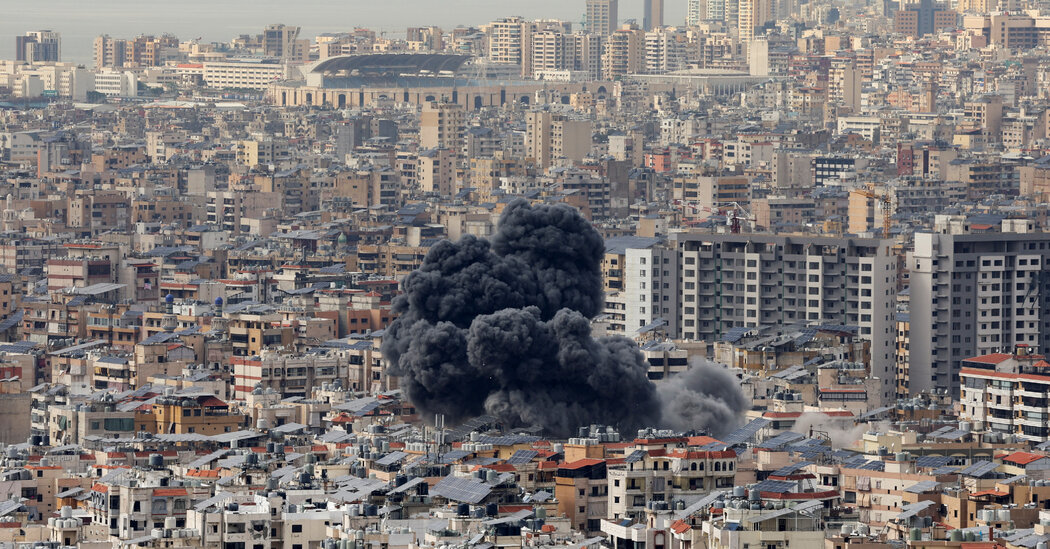

The Israeli military launched airstrikes on Beirut’s southern outskirts on Friday, its first such action since a U.S.-brokered cease-fire took effect last November. The strikes shattered months of tense calm in the Lebanese capital and ignited fears of escalating violence. Israeli forces targeted a site believed to store Hezbollah’s drones, without explicitly blaming the group for the earlier rocket fire on northern Israel. Hezbollah, however, denied involvement and maintained its commitment to the cease-fire. These attacks mark the second exchange of fire in less than a week, raising concerns about the stability of the truce between Israel and Hezbollah.
The day began with rockets launched from Lebanon toward northern Israel, triggering air-raid sirens in bordering communities. Israeli officials issued evacuation orders for the densely populated Hadath neighborhood of Dahiya, a Hezbollah stronghold on Beirut’s southern edges, ahead of the retaliatory strikes that followed just two hours later. The rockets, one intercepted and another landing within Lebanese territory, prompted a response that was swift and intense. Israeli drones hovered over Beirut, and gunfire from the ground attempted to warn residents of the impending assault, escalating tensions in the area.
In the aftermath, schools in affected neighborhoods closed, and social media captured frantic scenes of parents collecting children amid rising panic. Eyewitness reports described a city thrown back into chaos, reminiscent of the brutal days of conflict when airstrikes were a constant threat. “People are panicking,” said Elie Hachem, director of St. Therese hospital, located just 600 meters from the targeted site. While the hospital emerged unscathed from the attack, casualties soon filled its emergency room. Hachem expressed a focus on keeping the situation under control amid the rising tension.
Lebanon’s Prime Minister Nawaf Salam swiftly condemned the rockets fired earlier, labeling them “irresponsible” and a direct threat to Lebanon’s stability. Salam ordered security forces to apprehend those behind the attack, a move reflecting the Lebanese government’s distancing from Hezbollah, which, despite its dominant presence, operates separately from the state. The international community, spearheaded by U.N. special coordinator Jeanine Hennis-Plasschaert, urged restraint. She warned against a “return to wider conflict” that could devastate Lebanon once more.
Historically, the region has been a flashpoint for conflict. Hezbollah has, in the past, aligned with Palestinian groups like Hamas, which operate primarily from established refugee camps in Lebanon. This latest surge in hostilities occurs in the shadow of the war in Gaza, exacerbated by the Hamas-led October 7, 2023, attack that resurrected full-scale warfare after nearly a year of low-level violence, leading to the Israeli ground invasion and subsequent ceasefire.
Despite the truce, Israeli actions in Lebanon have been sporadic, focusing mainly on areas outside Beirut. However, Friday’s strike in Dahiya underscores a notable deviation, as this stronghold had remained untouched since the cease-fire’s inception. With ongoing violence threatening the fragile peace and the Lebanese government’s renewed commitment to security, all eyes are on the region, hoping for a restoration of calm amidst a backdrop of uncertainty.
Hwaida Saad and Dayana Iwaza contributed reporting from Beirut.
Original Source: https://www.nytimes.com/2025/03/28/world/middleeast/israel-beirut-evacuation-hezbollah.html
Category : Israel,Lebanon,Hezbollah,Middle East,Hamas,Israel-Gaza War (2023- ),War and Armed Conflicts
Tags:
Publish Date: 2025-03-28 19:42:00