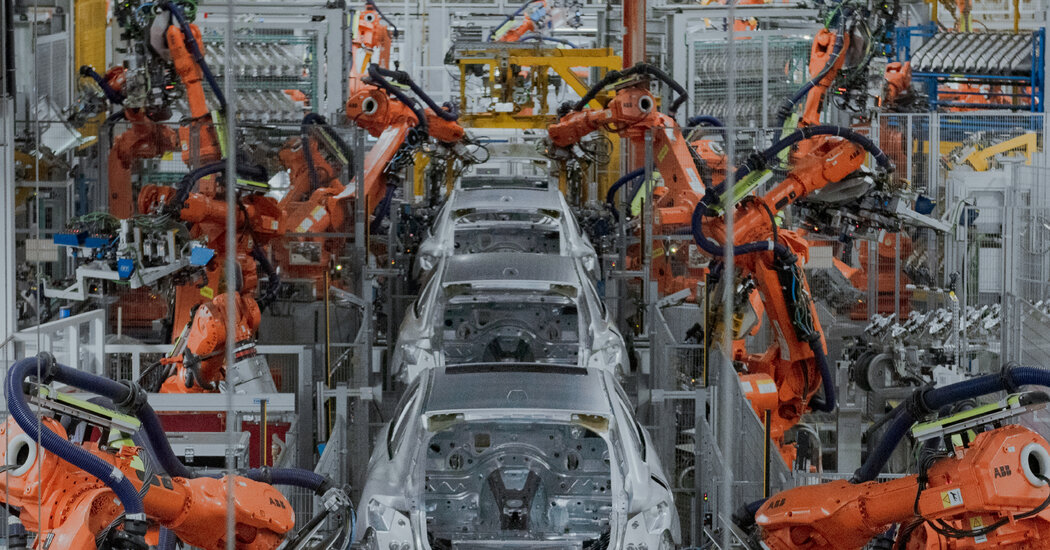

President Donald Trump’s decision to impose a 25 percent tariff on imported cars and parts is sparking fears of a global trade war. The move, aimed at encouraging companies to shift manufacturing to the United States and create more jobs, has rippled through the global markets, impacting automotive shares in Asia, Europe, and the U.S. These tariffs, set to take effect next Thursday, target all imported vehicles and certain auto parts. With countries like Mexico, Japan, South Korea, and Canada representing approximately 75 percent of U.S. vehicle imports, major car manufacturers are bracing for potential repercussions.
The policy is testing Trump’s unconventional approach to trade, which he believes will benefit domestic manufacturing. However, economists warn the effects could be more complex, potentially causing unintended damage. Mark Carney, responding for Canada, expressed concern, labeling the U.S. as “no longer a reliable partner.” He confirmed that Canada plans to announce countermeasures soon. In Germany, Economic Minister Robert Habeck emphasized the European Union’s need for a strong reaction, stating that it’s essential they “deliver a decisive response” to the tariffs.
Simultaneously, European leaders are deliberating France’s proposal for a “reassurance force” to maintain peace in a postwar Ukraine. French President Emmanuel Macron admitted the specifics need further definition. This proposal arises after U.S.-mediated discussions in Saudi Arabia resulted in tentative agreements between Russia and Ukraine to mitigate hostilities in energy sectors and Black Sea conflicts. Russia seeks concessions such as lifting banking restrictions and reconnecting to the Swift payment system, which requires European allies’ consent, a point of contention as they are excluded from these talks.
Meanwhile, Gaza is witnessing small yet significant public protests demanding an end to Hamas’s governance and the persistent conflict. Historically, Hamas has suppressed dissent forcefully. This time, their security forces have been less visible, likely due to complexities with their constituents and the looming threat of Israeli airstrikes. Protest organizer Ahmad al-Masri voiced the frustrations of many, declaring, “Hamas needs to go away.” This civil unrest occurs amid Israeli Prime Minister Benjamin Netanyahu’s coalition efforts to reform the judicial system, a move that has previously caused national division.
In addition, the situation in Yemen remains precarious, with Middle East analysts skeptical about easily defeating the Iran-backed Houthis, despite some U.S. claims exchanged via Signal chats. Meanwhile, a lesser-known facet of nature has emerged: sharks, believed to be silent, have now been recorded by scientists in New Zealand producing clicks likely made by snapping their teeth.
In architectural legacy news, iconic architect David Childs, known for his work on New York’s 1 World Trade Center, passed away at 83. His contributions have left a lasting mark on the city’s skyline following the tragic events of 9/11.
In Germany, the complex relationship with its wartime past continually resurfaces as efforts by the Volksbund, tasked with locating and honoring the graves of German soldiers from past wars, seeks to reconcile historical memory with present-day acknowledgments.
This trade and geopolitical overview underscores the intricate web of international relations, economic strategies, and historical contexts influencing today’s headlines. For more insights and detailed updates on these evolving stories, stay connected with us.
Original Source: https://www.nytimes.com/2025/03/28/briefing/auto-tariffs-ukraine-gaza.html
Category :
Tags:
Publish Date: 2025-03-28 10:30:00