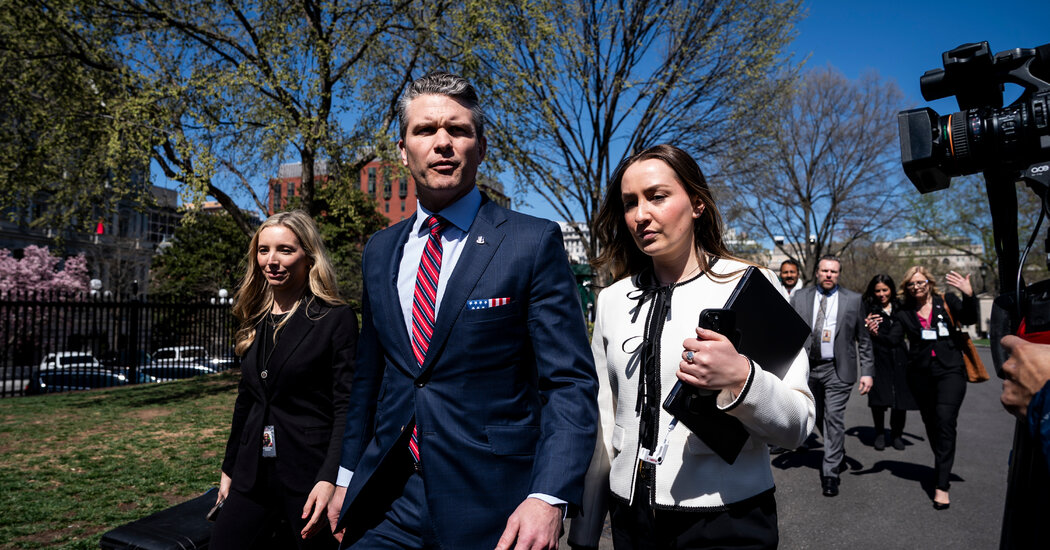
Shocking Revelation: Hegseth’s Secret War Plans Exposed in Explosive Chat with Atlantic Journalist

In an unexpected breach of national security that has drawn widespread concern, U.S. Defense Secretary Pete Hegseth inadvertently shared crucial war plans via an encrypted Signal group chat, which included a journalist from The Atlantic, just hours before a military assault on Houthi positions in Yemen. The White House confirmed the incident on Monday, highlighting an unprecedented lapse in operational security.
Jeffrey Goldberg, editor-in-chief of The Atlantic, recounted how he was mistakenly added to the secure messaging group by Michael Waltz, the national security advisor. This group also included prominent figures such as Vice President JD Vance and Secretary of State Marco Rubio. The misstep placed sensitive military information at risk, as this conversation occurred outside the usual secure government channels designated for classified communications.
According to Goldberg, two days prior to the military strikes, he was privy to discussions that shifted from routine procedural matters to unveiling operational details about the impending attack. At 11:44 a.m. on March 15, Hegseth reportedly shared specifics about targets, weapon deployments, and the sequencing of the attacks. As Goldberg waited in a supermarket parking lot, the validity of these leaked plans was confirmed when airstrikes began at 1:55 p.m. Eastern time in Yemen’s capital, Sana.
Defense officials expressed astonishment over the choice to conduct these sensitive discussions on a commercial messaging platform, warning that such actions might contravene the Espionage Act. The potential exposure of military plans risked the safety of U.S. personnel and could have provided adversaries with significant advantages.
The incident has sparked political reaction in Washington. Senator Jack Reed, a leading Democrat on the Armed Services Committee, criticized the breach as a stark failure in operational security. While some Republican senators urged for a thorough investigation to establish facts, others, like House Speaker Mike Johnson, dismissed the necessity for further probes.
President Trump, addressing the media, claimed no prior knowledge of the communication mishap, stating, “I don’t know anything about it.” In contrast, National Security Council spokesman Brian Hughes acknowledged the thread’s authenticity and stated that steps were being taken to review the inclusion error.
The revelation has also led to renewed scrutiny of Hegseth’s past critique of former Secretary of State Hillary Clinton’s use of a private email server—an issue he vehemently criticized. Social media users quickly drew parallels, pointing out the apparent irony in the situation. Meanwhile, Clinton herself highlighted the incident by reposting The Atlantic’s report with a sardonic remark.
This development is a notable instance of the complexities involved in modern communication technologies intersecting with military and political realms. As the full implications unfold, it underscores a significant moment of reflection on the protocols governing national security information in an increasingly digital world.
Original Source: https://www.nytimes.com/2025/03/24/us/politics/hegseth-classified-war-plans-group-chat.html
Category : United States Politics and Government,War and Armed Conflicts,Classified Information and State Secrets,United States Defense and Military Forces,Mobile Applications,Atlantic, The (Magazine),Defense Department,Houthis,National Security Council,Signal (Open Whisper Systems),State Department,Trump, Donald J,Hegseth, Pete,Goldberg, Jeffrey,Rubio, Marco,Vance, J D,Waltz, Michael (1974- ),Yemen,Middle East
Tags:
Publish Date: 2025-03-25 11:00:00