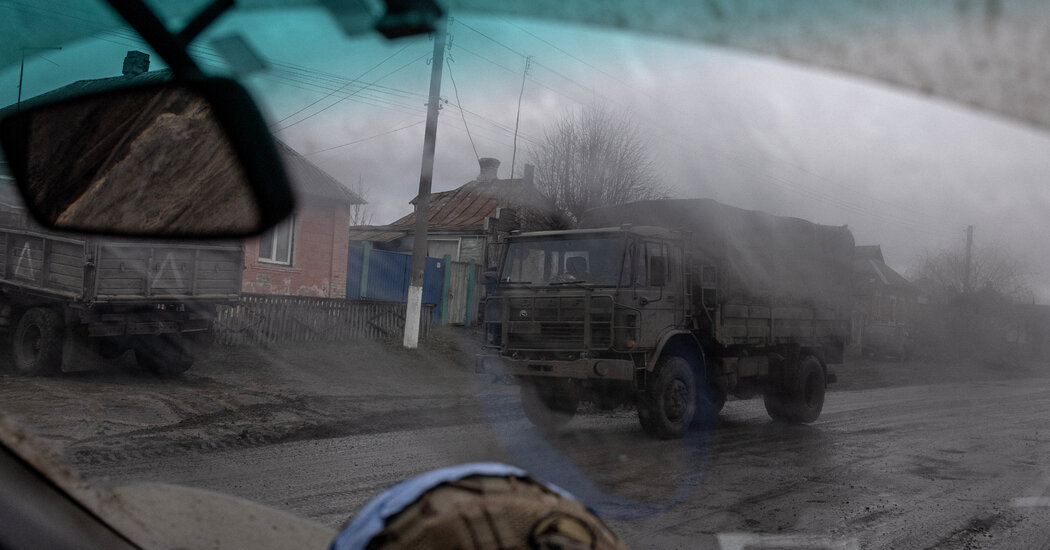

Ukrainian forces have strategically withdrawn from most of their occupied areas in Russia’s Kursk region, retaining control over a narrow strip of land along the border. This development, reported by both military analysts and soldiers on the ground, signifies a shift in the prolonged campaign to capture Russian territory. At the zenith of their operation, Ukrainian troops held approximately 500 square miles of Russian land. Now, according to Pasi Paroinen, a military analyst with the Finland-based Black Bird Group, they cling to roughly 30 square miles.
The exact extent of territory still under Ukrainian control has yet to be confirmed independently, as fierce fighting continues. However, recent days have seen Ukrainian forces retreat from multiple villages in the Kursk region and the main town of Sudzha. This pullback follows a rapid Russian advance bolstered by relentless airstrikes and drone attacks. The Ukrainian military command states that the troops have repositioned to more defensible areas, leveraging hilly terrain to improve their strategic standing against approaching Russian forces.
Despite the apparent retreat, Ukrainian soldiers assert that the ongoing conflict is more about securing strong defensive positions than maintaining Russian territory. These positions aim to prevent further Russian advances into Ukraine’s Sumy region, potentially opening a new front in the war. An assault platoon commander, known only by the call sign Boroda, commented on the determined stance: “We continue to hold positions on the Kursk front. The only difference is that our positions have shifted significantly closer to the border.”
Military experts note that this retreat results from intense Russian assaults over recent months that diminished Ukraine’s foothold, eventually forcing the withdrawal. Franz-Stefan Gady, an Austrian military analyst, observed that this chain of events was part of a strategic operation leading to a successful Russian counteroffensive.
Since December, Russian forces, with additional support from newly deployed North Korean troops, have repeatedly attacked the Ukrainian-held areas in Kursk. By mid-February, Russian forces were five miles from the main Ukrainian resupply routes into Sudzha and began targeting these roads with drone swarms. Following the Defense Ministry’s claim, the Russians asserted control over Sudzha and nearby villages late last week.
This withdrawal contrasts with previous hasty retreats from eastern Ukraine, as analysts describe it as relatively orderly, avoiding the encirclement of Ukrainian troops. Serhii Kuzan from the Ukrainian Security and Cooperation Center emphasizes, “There was no threat of encirclement of Ukrainian troops, and no evidence suggests otherwise.”
Kyiv’s initial strategy of using its control over Kursk for leverage in war negotiations faces challenges as Ukraine supports a U.S.-backed ceasefire proposal, conditional on Russian compliance. The Kremlin has yet to agree, potentially extending the negotiation timeline. Steve Witkoff, Donald Trump’s special envoy to the Middle East, acting as an intermediary with Russia, relayed optimism after a lengthy meeting with Vladimir Putin and expects further discussions this week. Additionally, the State Department revealed that Secretary of State Marco Rubio and Russia’s Foreign Minister Sergey Lavrov discussed next steps, though details remain sparse.
These developments occur amid a backdrop of continued diplomatic efforts to resolve the conflict, highlighting the ongoing complexities of the Russian invasion of Ukraine.
Original Source: https://www.nytimes.com/2025/03/16/world/europe/kursk-russia-ukraine.html
Category : Russian Invasion of Ukraine (2022),Lavrov, Sergey V,Putin, Vladimir V,Rubio, Marco,Trump, Donald J,Kursk (Russia),Moscow (Russia),Russia,Ukraine,Sumy (Ukraine)
Tags:
Publish Date: 2025-03-17 00:44:00