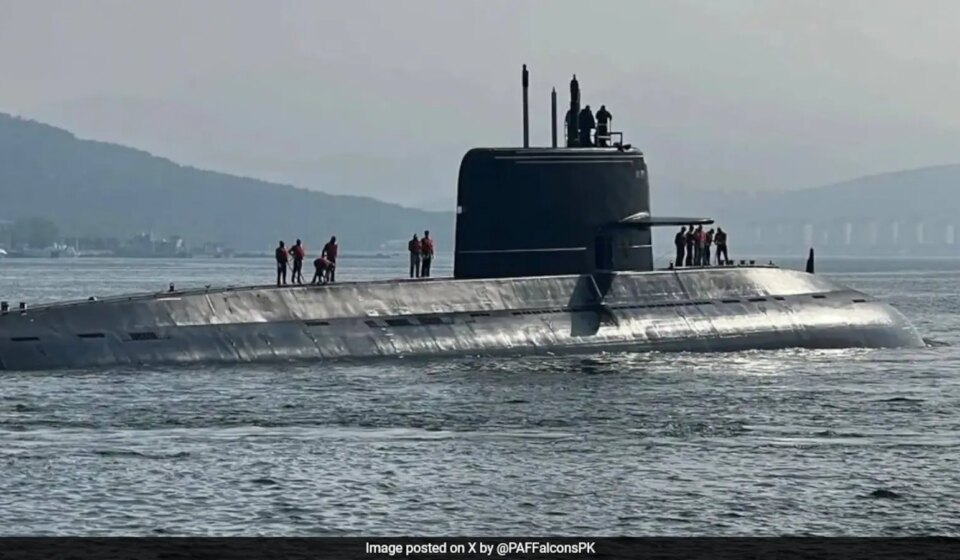

Over a decade after Pakistan and China signed a landmark submarine acquisition agreement during Chinese President Xi Jinping’s visit to Islamabad in April 2015, Pakistan has inducted its first Hangor-class boat, PNS Hangor — the opening delivery in what the contract described as the largest defence purchase in the country’s history. Under the original terms, Pakistan was to receive eight Hangor-class submarines: four built in China and delivered by 2022–2023, and four assembled at Karachi Shipyard and Engineering Works (KSEW) by 2028.
As of 2026, however, only PNS Hangor has entered service. Three other China-built boats — PNS Shushuk, PNS Mangro and PNS Ghazi — have been launched and are reported to be undergoing advanced sea trials, but none of them had been formally commissioned by the original deadline, which has thus lapsed. Pakistani officials have not published revised delivery deadlines for the programme.
Multiple factors are cited for the slippage. A key technical and regulatory setback came when Germany refused export licences for the MTU engines originally selected for the class, forcing Pakistan and its builder to switch to Chinese-made CHD-620 diesel engines. The COVID-19 pandemic and the complexities of integrating an entirely new submarine design further slowed progress, according to the available information.
Observers now expect the full eight-boat fleet to enter service between 2028 and 2030, with defence analysts suggesting the three China-built boats could be commissioned relatively quickly once sea trials conclude. The outlook for the four boats to be assembled domestically at KSEW is more uncertain. Work on the fifth submarine only began in December 2021, and the sixth received its keel-laying in February 2025 — later than originally planned.
KSEW has received substantial investment to expand its submarine-building capacity, including installation of a new Ship Lift and Transfer System, but experts note that producing a new class remains technically demanding. Pakistan’s prior domestic experience includes production of the Agosta 90B-class PNS Hamza, commissioned in 2008, yet the Hangor programme is larger in scale, complexity and cost.
Estimated at between $4 billion and $5 billion, the Hangor-class procurement is described as Pakistan’s most expensive naval programme. Large defence contracts often include penalties for missed delivery dates; the Pakistan Ministry of Defence has not disclosed whether such clauses exist in the Hangor deal or whether any penalties have been assessed for delays or cost overruns.
Original Source: https://www.ndtv.com/world-news/crippled-by-delays-pakistans-ambitious-submarine-programme-gasps-for-breath-11656649#publisher=newsstand
Category:
Tags:
Publish Date: 2026-06-18 23:49:00