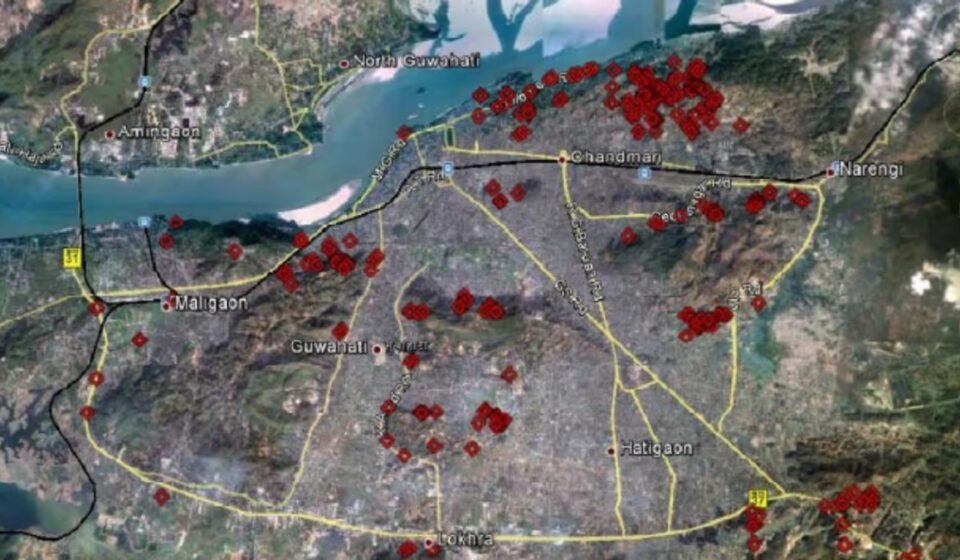

A comprehensive survey of 366 landslide‑vulnerable sites across Guwahati has found that the vast majority of slope failures are caused by human activity rather than natural processes, underscoring the growing risks posed by unplanned urban development to the city’s fragile hill ecosystem. The assessment warns that immediate action is needed at many locations to prevent loss of life and property.
The study mapped vulnerable spots across 20 localities — including Fatasil, Garbhanga, Gotanagar, Hengerabari, Jalukbari‑Lankeswar, Kahilipara, Kalapahar, Kamakhya‑Nilachal, Khanapara, Kharguli, Koinadhora, Maligaon, Nabagraha, Narakasur, Narengi, Noonmati, Santipur, Sarania, Sukreswar and Sunsali. Kharguli recorded the highest number of at‑risk sites (77), followed by Noonmati (40), Narengi (37), Khanapara (33), Maligaon (31) and Jalukbari‑Lankeswar (30).
The assessment attributes 95% of landslide‑prone locations to man‑made causes and only 5% to natural factors. Reported drivers include uncontrolled hill cutting, construction on steep slopes, inadequate drainage and unregulated urban expansion — all of which undermine slope stability and increase erosion.
Slope geometry and size were analysed: 88% of vulnerable slopes have an inclination of up to 60 degrees, 7% exceed 60 degrees, and 5% are described as negative slopes (concave or inward‑facing profiles). In terms of height, 57% of sites are less than five metres tall, 20% fall between five and ten metres, 18% between 11 and 15 metres, and 5% exceed 15 metres.
Vegetation cover is poor at many locations: nearly 45% of vulnerable slopes lack vegetation, 36% have only grass and bushes, and 19% retain tree cover — the latter generally providing the best natural protection against erosion. Geologically, 62% of slopes are a mix of rock and soil, 34% are soil only, and 4% are rock only.
A key concern is urgency: 74% of identified sites require immediate intervention, while 26% need comparatively less urgent attention. To support monitoring, all surveyed locations have been plotted and superimposed on Google Earth, giving authorities a visual hazard map to aid disaster preparedness and planning.
The report calls for stricter regulation of hill cutting, improved drainage infrastructure, targeted afforestation programmes and scientific land‑use planning to reduce landslide risk in Assam’s largest city and protect communities living on and below the hills.
Original Source: https://www.indiatodayne.in/assam/story/guwahatis-hills-under-threat-366-landslide-vulnerable-sites-identified-1408348-2026-06-15?utm_source=rssfeed
Category:
Tags:
Publish Date: 2026-06-15 13:53:00