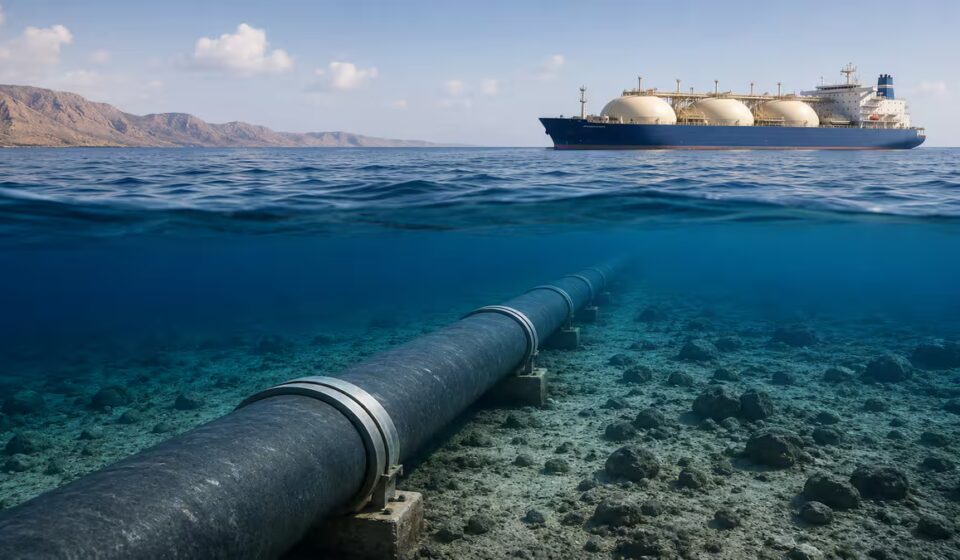

The escalating crisis in West Asia has renewed interest in a decades-old proposal to lay a nearly 2,000-kilometre undersea gas pipeline from Oman to Gujarat, a project proponents say could shore up India’s energy security if maritime routes through the Strait of Hormuz are disrupted. Estimated at about Rs 40,000 crore, the Oman‑Gujarat Deep‑Sea Gas Pipeline has been on the drawing board for more than 30 years but is being revisited by policymakers and industry experts amid fears of supply shocks.
The Strait of Hormuz links the Persian Gulf to the Arabian Sea and handles roughly one‑fifth of the world’s oil trade, as well as a significant share of liquefied natural gas (LNG) shipments. Recent hostilities in West Asia have pushed crude and gas prices up and raised shipping costs, underscoring India’s exposure: the country imports nearly 85 percent of its crude oil and depends heavily on overseas gas, much of it shipped through Hormuz.
Planned as a direct subsea corridor often called the Middle East–India Deepwater Pipeline, the project would carry pipeline gas from Oman to India’s western coast. Unlike LNG, which must be chilled, shipped on specialised tankers and regasified on arrival, pipeline gas would flow directly-potentially offering a steadier, more predictable supply and reducing reliance on vulnerable shipping lanes. Supporters also say the link could deepen India‑Oman ties and provide an entry point to other Gulf gas supplies.
Technically, the proposal is unusually ambitious. Large portions of the route would run at depths exceeding 3,000 metres, with some estimates up to about 3,450 metres-making it one of the deepest subsea pipeline concepts ever proposed. Installation and maintenance at such depths would require advanced engineering and specialised vessels, and any failure or leak would be costly and difficult to repair. Project documents suggest transport costs of roughly $2 to $2.25 per million British thermal units (MMBtu), but actual economics would depend on financing, construction costs and future gas prices.
The plan has been studied repeatedly over the past three decades. South Asia Gas Enterprise (SAGE), a long‑time advocate, reports seabed surveys and technical and financial assessments. According to reports, the Petroleum and Natural Gas Ministry has asked state firms including GAIL, Engineers India and Indian Oil to prepare a detailed feasibility study based on SAGE’s prefeasibility work.
Major hurdles remain: engineering complexity, uncertain commercial returns, risk of cost overruns and the challenge of securing financing and long‑term supply contracts. For now the pipeline is still a proposal rather than a project, but rising geopolitical risks have reframed it from an engineering curiosity into a strategic option for diversifying India’s energy routes.
Original Source: https://www.firstpost.com/business/india-oman-pipeline-dream-revived-west-asia-turmoil-energy-security-hormuz-gujarat-gas-pipeline-14020746.html
Category: India
Tags:
Publish Date: 2026-06-10 07:34:00