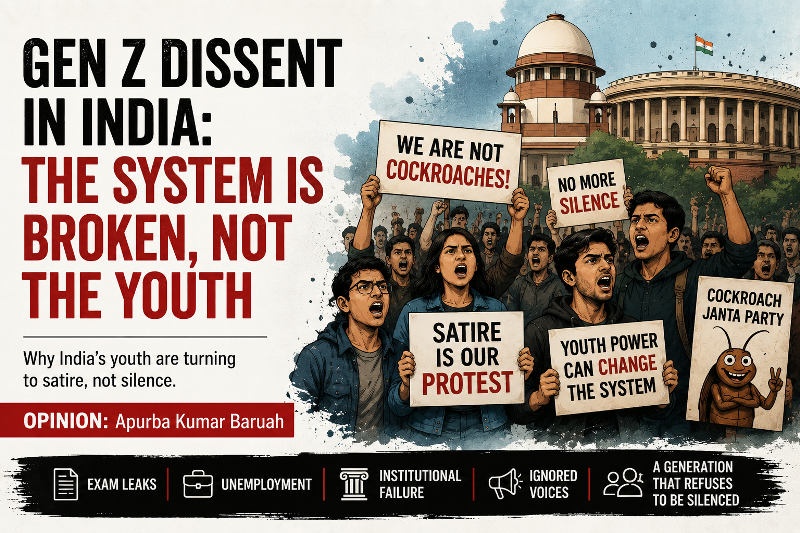

Shashi Tharoor’s recent appeal in The Indian Express asking Generation Z to “join the system” rather than agitate against it has drawn sharp criticism from retired political scientist Apurba Kumar Baruah, who argues that many young people no longer trust the system and believe it must be challenged. Baruah says Tharoor-long a privileged member of Parliament and a former diplomat-offers a comforting institutional roadmap that ignores the everyday failures driving youth anger: repeated exam-paper leaks, perceived CBSE evaluation anomalies and the persistent problem of unemployment.
Tharoor’s prescription-channel online outrage into conventional Westminster-era tactics such as flooding local MLA offices with complaints and using the Right to Information (RTI) Act-rings hollow for a generation that sees institutional routes as compromised. Baruah contends that a politician steeped in diplomatic practice underestimates the “deep structural decay” in politics and therefore fails to grasp why Gen Z prefers satire and digital dissent to formal reform processes.
The Cockroach Janta Party (CJP) movement, Baruah writes, is not merely cathartic. It is a deliberate attempt to subvert a political system that, in young protesters’ view, refuses to hear legitimate grievances. He points out that satire, as commentator Yogendra Yadav told the BBC, often expresses pain; and that Gen Z’s protests have so far remained non‑violent, choosing mockery over street confrontation.
Events on 6 June, Baruah argues, showed that this satirical language has become a unifying medium for many young people who feel excluded from mainstream politics. While Tharoor urges partnerships with student unions, legal collectives and policy organisations to turn hashtags into legislation or petitions, Baruah questions whether today’s legislatures and courts inspire confidence among those who feel deprived.
Baruah singles out a flashpoint that intensified distrust: he recalls how a senior judicial figure’s comments, which referred to unemployed youth in highly pejorative terms, undermined faith in institutional channels for dissent. For many young people, that episode was among the final blows to the credibility of existing mechanisms for redress, and it helped fuel the CJP’s momentum.
There are also fears that the movement could be co‑opted. Observers who remember the India Against Corruption campaign worry similar currents-if absorbed by establishment forces-could end up reinforcing cronyism and communal divisions rather than weakening them. Yet, given the widespread fury over examination scandals and job insecurity, the state may have decided that heavy‑handed suppression risks sparking uncontrolled street unrest, at least for now leaving the CJP space to mobilise.
Baruah notes that the CJP diagnosis reaches beyond test fraud: leaders like Dipke have argued that confronting communal politics is essential if constitutional democracy is to endure. International commentators such as Christophe Jaffrelot, Baruah adds, see the CJP as “the voice of the resentment felt by Indian youth” not only against incompetence and corruption but, above all, against unemployment.
The movement, Baruah concludes, shows how constitutional values must be linked to daily economic realities if democratic forces hope to reconnect with ordinary citizens. The urgent question is not whether Gen Z should enter the system, he argues, but whether the system itself is willing to listen. The Cockroaches have posed that question; the answer will shape both the movement’s future and the trajectory of Indian democracy.
Original Source: https://nenow.in/opinion/cockroach-janta-party-and-the-political-establishment-a-growing-disconnect-in-indian-politics.html
Category: Opinion,Top News
Tags:
Publish Date: 2026-06-09 23:50:00