
Dimapur, June 4 — Nagaland has registered notable improvements in maternal and child health between NFHS-5 and the provisional NFHS-6 (2023–24) fact sheets, with gains in antenatal care, institutional deliveries, skilled birth attendance and several child immunisation measures, but most indicators still lag behind national averages.
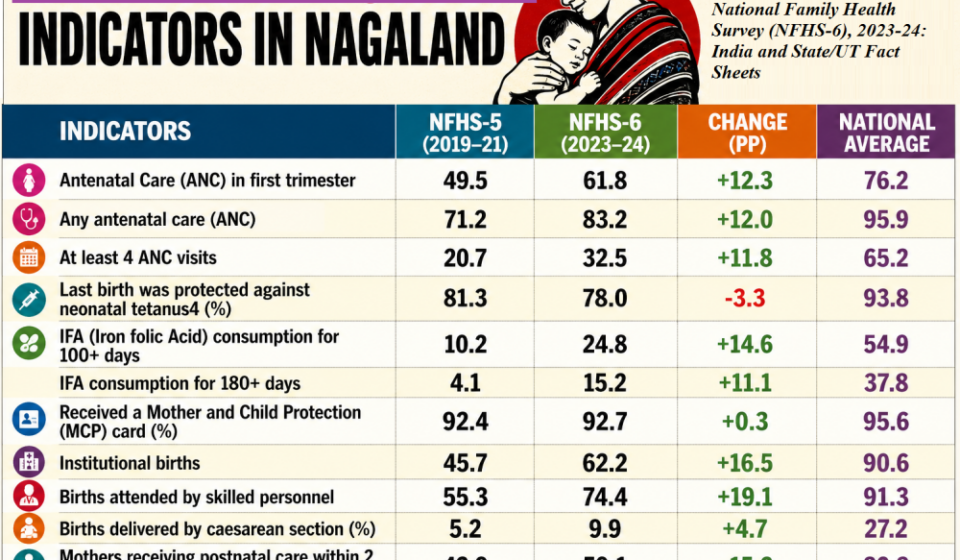
The proportion of women receiving antenatal care in the first trimester rose from 49.5% in NFHS-5 to 61.8% in NFHS-6, while any antenatal care increased from 71.2% to 83.2%. Women receiving at least four ANC visits climbed from 20.7% to 32.5%. Consumption of iron and folic acid (IFA) supplements for at least 100 days nearly doubled to 24.8% from 10.2%, and those taking IFA for 180 days or more rose to 15.2% from 4.1%.
Delivery care showed some of the largest gains: institutional births increased by 16.5 percentage points to 62.2%, and births attended by skilled health personnel rose from 55.3% to 74.4%. Caesarean section deliveries grew from 5.2% to 9.9%, remaining well below the national average of 27.2%. Postnatal care also improved, with mothers receiving care within two days rising from 43.9% to 59.1% and newborns receiving postnatal checks within two days increasing from 41.8% to 60.2%. Coverage of Mother and Child Protection cards stayed high at about 92.7%.
Not all maternal indicators improved: protection against neonatal tetanus fell slightly from 81.3% to 78.0%. Despite progress, Nagaland remains below national benchmarks on key measures — for example, first-trimester ANC is 61.8% in the State versus 76.2% nationally, four-or-more ANC visits are 32.5% against 65.2% nationally, institutional births 62.2% versus 90.6%, and skilled birth attendance 74.4% compared with 91.3% nationwide.
Child immunisation saw significant advances. Fully vaccinated children aged 12–23 months rose from 57.9% to 64.3%, and among those with vaccination cards full immunisation moved from 71.3% to 74.2%. Three-dose coverage for polio reached 68.5% (from 65.4%) and for pentavalent it reached 73.4% (from 71.7%). Hepatitis B birth-dose improved to 46.4% and Vitamin A supplementation to 56.5%. Rotavirus vaccine coverage recorded the largest jump, surging from 6.5% to 68.5%. Measles-containing vaccine coverage also increased: first dose to 79.4% and second dose to 62.7%. Overall, 91.1% of children aged 12–23 months received at least one vaccine, higher than the national 87.1%, but full immunisation in Nagaland (64.3%) remains below the national figure of 82.6%.
The NFHS-6 was conducted in 2023–24 by the Union Ministry of Health and Family Welfare with the International Institute for Population Sciences (IIPS), Mumbai, as nodal agency. National provisional fact sheets covering nearly 679,238 households were released on May 29; the detailed report is still awaited. In Nagaland, fieldwork ran from August 26, 2023, to March 5, 2024, covering 11,104 households, 9,693 women and 1,635 men. Continued focus and investment are needed to close the gap with national benchmarks and sustain gains in maternal and child health.
Original Source: https://www.morungexpress.com/nfhs-6-nagaland-records-strong-gains-in-maternal-child-health
Category: Morung Exclusive , Nagaland
Tags:
Publish Date: 2026-06-04 22:22:00