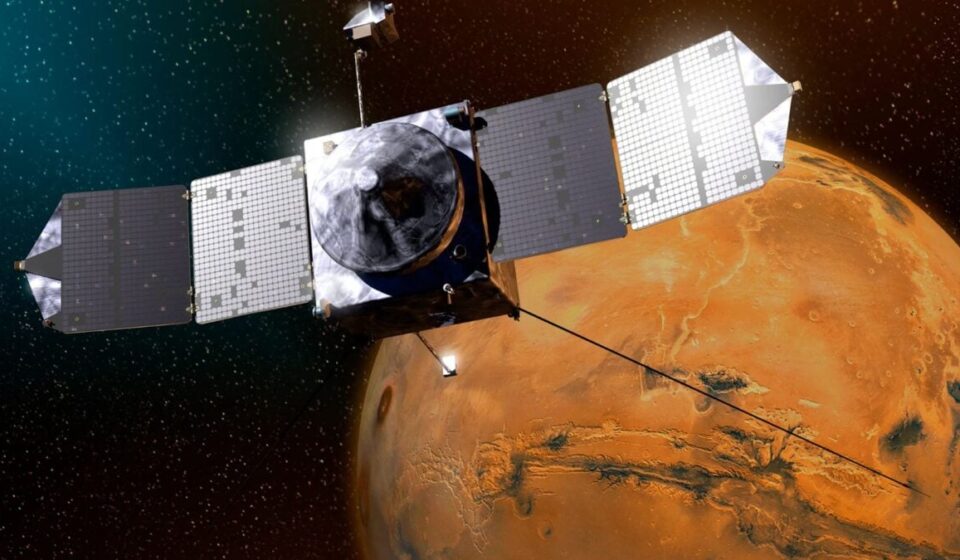

NASA has formally ended the Mars Atmosphere and Volatile Evolution (MAVEN) mission after six months of unsuccessful recovery attempts following a loss of contact on December 6. The agency says the 11-year-old orbiter is “not recoverable” and “no longer capable of performing its science and data relay mission,” bringing to a close a program that transformed understanding of how Mars lost its air and water.
MAVEN launched in November 2013 and arrived at Mars within a year. Its primary mission was planned for one year, but the spacecraft continued operating for more than a decade, returning continuous measurements of the Martian atmosphere and acting as a communications relay for surface rovers. NASA has noted the probe had carried fuel sufficient to operate until about 2030, yet contact was lost after the spacecraft reemerged from behind Mars on December 6 and did not respond to repeated commands.
Telemetry before the signal loss showed systems functioning normally. A small fragment of tracking data later suggested the orbiter entered safe mode and began rotating at an unusual rate. Investigators say that the unexpected spin likely drained MAVEN’s batteries and led to the failure of its communications system. A formal review board concluded the spacecraft cannot be recovered, although NASA continues to probe the anomaly’s root cause.
Scientifically, MAVEN leaves a substantial legacy. The mission made the first direct observation of atmospheric “sputtering,” a process in which charged particles knock atoms out of the upper atmosphere. Because Mars lacks a global magnetic field, its atmosphere is vulnerable to erosion by the solar wind; MAVEN’s measurements confirmed sputtering as a key driver of long-term atmospheric loss and helped explain where ancient Martian water went.
MAVEN’s data also revealed a new type of Martian aurora and showed that atmospheric stripping intensifies during solar storms. Louise Prockter, director of NASA’s Planetary Science Division, said MAVEN’s findings are crucial for designing radiation protection and other safety measures for future crewed missions and that the mission’s datasets will continue to inform Mars exploration for decades to come.
Original Source: https://gizmodo.com/nasa-just-delivered-the-mars-orbiter-update-nobody-wanted-to-hear-2000767425
Category:
Tags:
Publish Date: 2026-06-04 20:45:00