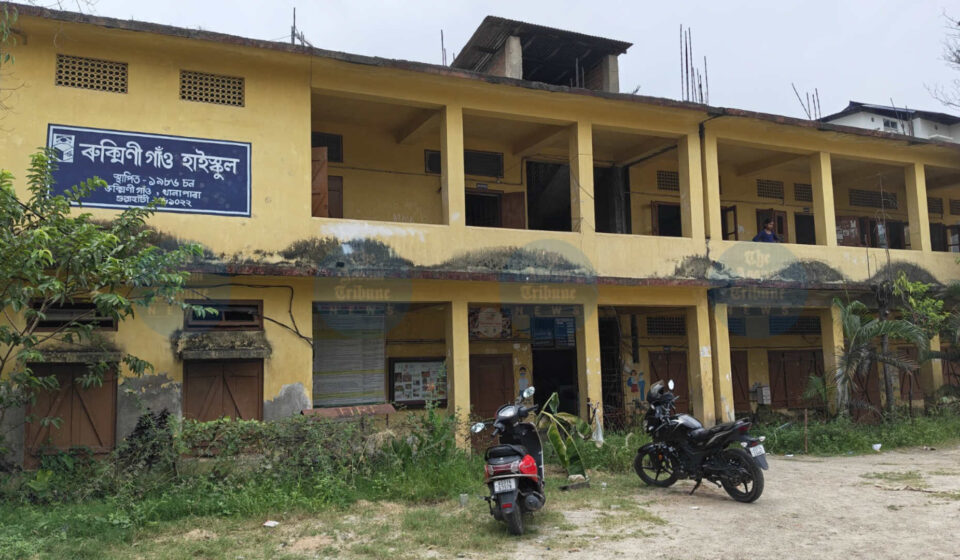

On June 3, Assam Chief Minister Himanta Biswa Sarma announced on social media that Assam had entered the top three Indian states for school internet connectivity, with 87.2% of schools connected-a milestone recognised by NITI Aayog. A few kilometres from Dispur, however, Rukminigaon High School in flood-prone Guwahati paints a starkly different picture, where annual monsoon floods, lack of basic facilities and falling enrolment expose gaps behind the headline figures.
At Rukminigaon, classrooms turn into pools of stagnant water each monsoon. “Whenever there is artificial flooding, three to four feet of water enters the school campus. The entire ground floor becomes unusable. In reality, we can use the ground-floor classrooms for barely two months in a year. Even now, water remains in some areas,” Headmaster Dinabandhu Kalita told The Assam Tribune. Of 11 classrooms, only 10 are currently functional; the school faces a shortage of subject-specific teachers and Kalita has no separate office, managing administration in shared space with students.
The school’s physical decay has had clear consequences: enrolment has nearly halved over the past five years as parents grow reluctant to send children to a building with leaky roofs, dirty corridors and classrooms that are often flooded. In one striking image of neglect, fish have been spotted swimming through rooms meant for learning. Teachers report chronic difficulty conducting classes during flood season and no alternative arrangements when rooms are unusable.
“We have been struggling for years. Conducting classes becomes extremely difficult, especially during the flood season. There is no alternative arrangement for students when classrooms become unusable,” teacher Monika Medhi said, adding that repeated reports to concerned authorities have brought little improvement and that staff often arrange basic necessities themselves. Students feel the impact in cancelled lessons and weakened preparation: “Every year during May and June, waterlogging creates major problems. Even when there is no flooding, we face difficulties because of the lack of drinking water and poor toilet facilities,” said Hiramoni Haloi, a five-year student at the school.
Local residents describe the school’s decline as a moral failing. “Children are the future of our society. It is heartbreaking to see them study in such an environment,” said Minakshi Deka, while Sangita Kalita urged that government schools receive the facilities to allow students to study with dignity. Community grief adds pressure on authorities to act, but appeals over the years have produced little visible relief.
The school’s plight sits uneasily beside state-level gains in education and digital access. The recently released NFHS-6 shows an increase in the proportion of women aged 15–49 with ten or more years of schooling from 29.6% (NFHS-5) to 37.1%. Digital access among women rose sharply-internet use from 28.2% to 53.5% and mobile ownership from 57.2% to 66.8%—trends that highlight progress but also deepen the contrast with schools still lacking basics.
Educational improvements at the state level risk being fragile unless foundations are strengthened. Rukminigaon High School’s experience underlines that connectivity and statistics mean little without adequate classrooms, enough teachers, clean drinking water and basic flood protection so a child need not wade through water to reach her desk. Year after year, that assurance remains out of reach for this Guwahati community.
Original Source: https://assamtribune.com/guwahati/flooded-floors-empty-desks-no-water-the-guwahati-govt-school-progress-forgot-1612382
Category: Guwahati,Featured,More
Tags:
Publish Date: 2026-06-04 19:01:00