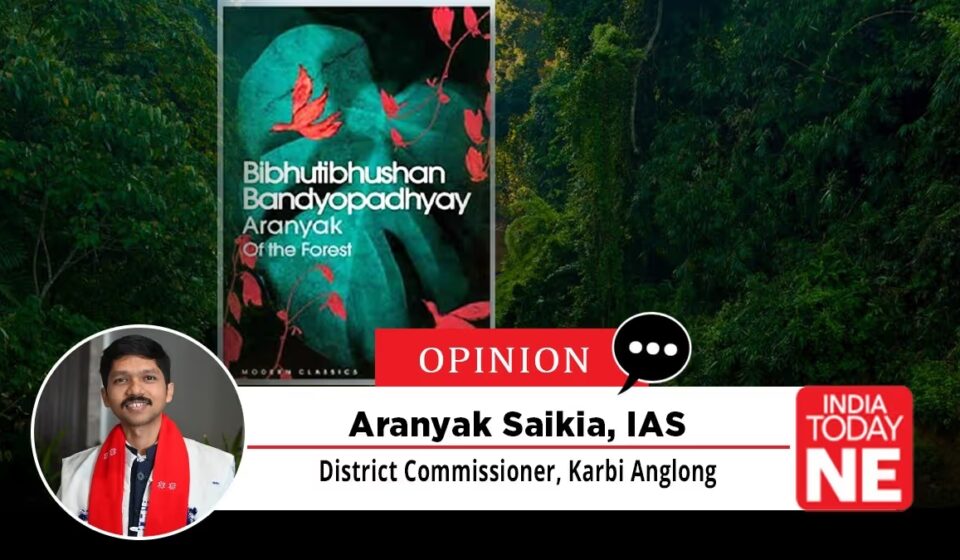

An IAS officer serving in Karbi Anglong revisits Bibhutibhushan Bandyopadhyay’s novel Aranyak and finds its depiction of forest life and loss uncannily relevant today. Prompted by a copy received as a parting gift after a transfer, the author reads the novel decades after first hearing about it as a child and sees how its central tension-between human settlement driven by market logic and an eco-centric respect for nature-remains unresolved nearly a century after publication.
The piece opens with a personal memory: early exposure to wildlife documentaries and a childhood fascination with forests and animals that made repeated references to Aranyak feel inevitable. Only recently, after finally reading the book, the author says, did the novel’s scenes and emotions fully take hold. Aranyak’s opening chapters vividly describe the forests of northern Bihar, where the protagonist Satyacharan arrives to manage a landlord’s estate. The forest is not mere setting but a living system that slowly reshapes Satyacharan’s outlook.
Satyacharan’s arc-from viewing the forest as a resource to feeling guilt and responsibility-anchors the novel’s moral inquiry. As he becomes intimate with the rhythms of the jungle and the lives of its inhabitants, his initial fear and detachment give way to longing and sorrow. That emotional shift underscores a larger economic dilemma: the estate must be converted into agricultural land and settlements because those uses generate revenue, while the forest does not.
The author emphasizes this contradiction as the book’s most prescient insight. Market systems routinely fail to internalize the environmental value of forests, producing local and global conflicts. Even with advances in natural resource accounting and tools such as hedonic pricing, the trade-off between immediate economic returns and long-term ecological services persists. Questions of who may convert forestland and which generation benefits remain unresolved.
Legal protections for forests exist, the author notes, but economic incentives ultimately shape outcomes. Aranyak does not prescribe policy; it offers perspective through human feeling and loss. The novel’s voice captures that inevitability: “Labtulia was gone forever, and so was Narha Baihar. But the hills of Mahalikharup and Dhanjhari still remained. Perhaps, a day would come when the people of the country would crave to see a forest…” This lament, the author argues, has been borne out by today’s reality.
Today forests attract visitors and generate an economy-eco-camps, resorts, guides and safaris-that can resemble pilgrimage. While that recognition assigns new economic value to forests, it also highlights how late such valuation often arrives. Aranyak, the author concludes, was decades ahead in framing these tensions through story and sentiment. The writer is an IAS officer currently serving as District Commissioner, Karbi Anglong, Assam. Views are personal.
Original Source: https://www.indiatodayne.in/opinion/story/aranyak-of-forests-1402290-2026-06-03?utm_source=rssfeed
Category:
Tags:
Publish Date: 2026-06-03 21:52:00