
NASA data show a surprising new space‑weather effect on Mars: measurements from the MAVEN spacecraft revealed the Zwan‑Wolf effect in Mars’s upper atmosphere during a large solar storm in December 2023, a phenomenon previously seen only near Earth’s magnetosphere. The finding, reported in Nature, is unexpected because Mars lacks a global magnetic shield; it suggests that solar storms can drive Earth‑like plasma behavior in the ionosphere of an unmagnetized planet. MAVEN-launched in November 2013 to study Mars’s atmosphere and how the planet lost much of it billions of years ago-provided the observations now reshaping how scientists view space weather on Mars. NASA has not reestablished contact with MAVEN since losing its signal on December 6, 2025; an anomaly review board is assessing the probe’s status.
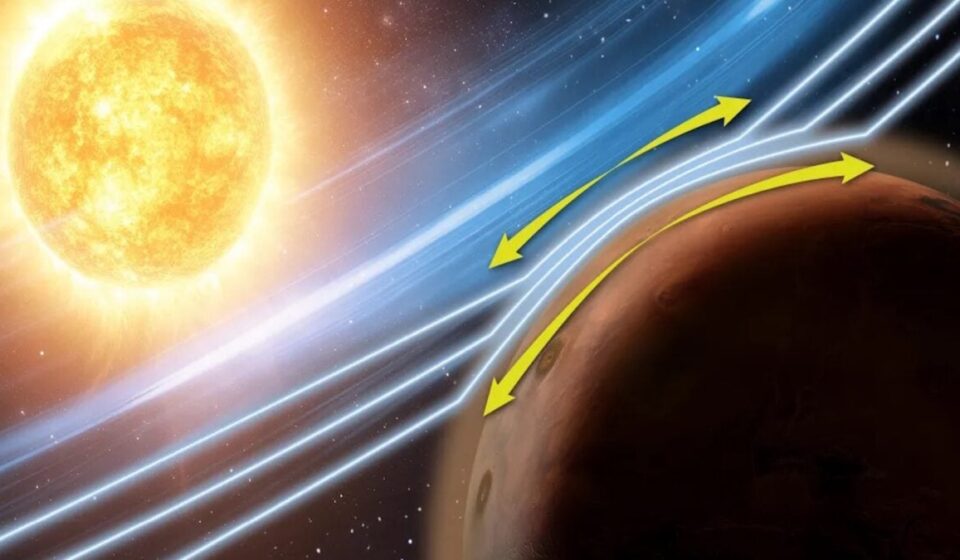
The Zwan‑Wolf effect occurs when charged particles are squeezed through magnetic structures called flux tubes as a magnetic field is compressed. On Earth this process helps redirect the solar wind around the planet’s magnetosphere; on Mars, MAVEN detected plasma behaving as if it were near Earth’s magnetospheric boundary, despite the Red Planet’s weak, patchy crustal fields. Scientists describe the motion as charged particles being pushed along field lines “like toothpaste coming out of a tube.”
Christopher Fowler, lead author of the study and a research assistant professor at West Virginia University, said the discovery began with an odd pattern in the data. “When investigating the data, I all of a sudden noticed some very interesting wiggles,” he said. “I would never have guessed it would be this effect, since it’s never been seen in a planetary atmosphere before.” Fowler added that “no one expected that this effect could even occur in the atmosphere,” highlighting the surprising physics revealed by the storm‑driven encounter.
Researchers examined magnetic‑field fluctuations and charged‑particle measurements from several MAVEN instruments, focusing on the ionosphere-the layer where solar radiation creates electrically charged plasma. After ruling out other explanations, the team concluded the Zwan‑Wolf effect was the most consistent cause. The study suggests the effect might occur at low, normally undetectable levels most of the time but became visible when the solar storm amplified the signals.
Shannon Curry, principal investigator of MAVEN, emphasized the result’s importance: “Knowing how space weather interacts with Mars is essential.” Beyond Mars, the finding offers new insight into how similar processes might operate at other unmagnetized worlds such as Venus or Titan, and it adds a fresh piece to the puzzle of atmospheric loss and space‑weather interactions that future missions will need to consider.
Original Source: https://gizmodo.com/nasas-maven-detects-atmospheric-effect-on-mars-that-no-one-expected-2000760584
Category:
Tags:
Publish Date: 2026-05-20 00:35:00