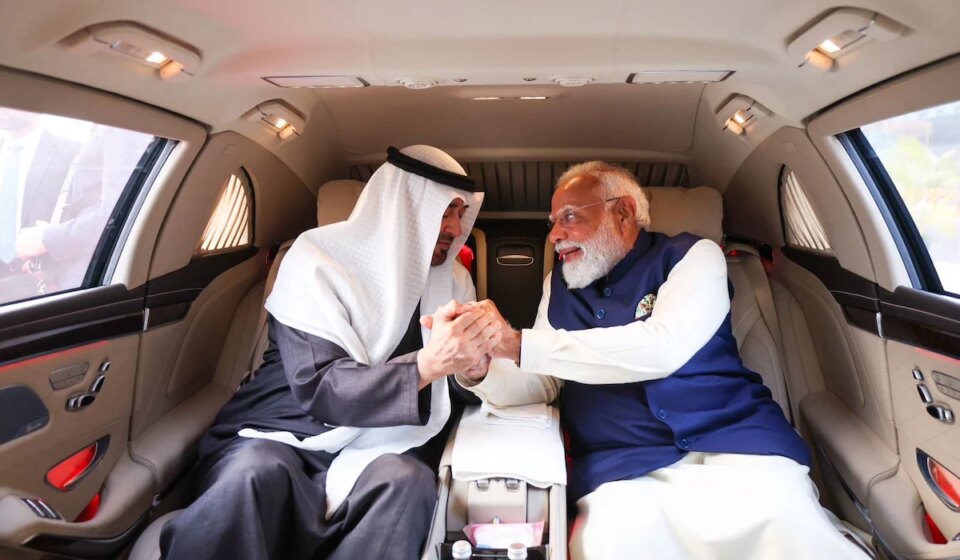

Prime Minister Narendra Modi flew to Abu Dhabi on May 15 as global fuel security sits on edge, meeting UAE President Sheikh Mohamed bin Zayed Al Nahyan at a moment when Middle East tensions threaten oil and gas flows. With the US-Israel war on Iran having rattled regional shipping lanes, higher insurance costs and freight uncertainty are already stirring nervousness among oil traders. Any disruption, analysts say, feeds quickly into pump prices, inflation and India’s current account-a key worry because India imports more than 85% of its crude oil.
Energy is expected to dominate the talks, but the agenda goes beyond spot supplies. Officials will discuss long-term crude and LNG contracts and possible UAE support to expand India’s Strategic Petroleum Reserves. India currently has three reserve sites with a combined capacity of 5.33 million tonnes; two additional sites with about 6.5 million tonnes are planned. Part of the existing storage is already leased to Abu Dhabi National Oil Company (ADNOC), and New Delhi may seek to extend that model.
New Delhi is likely to press for guaranteed long-term crude deliveries, increased LNG flows to secure cooking gas supplies, UAE participation in building more storage, and flexible supply terms to cope with disrupted shipping routes. The UAE’s exit from OPEC has given it more scope to raise output, making it a potential swing supplier at a time when others may be constrained. The visit could also build on a $3-billion LNG agreement India signed with the UAE in January.
Trade and investment will feature alongside energy. India and the UAE, which signed the Comprehensive Economic Partnership Agreement (CEPA) in 2022, have seen trade surge; the UAE is now India’s third-largest trading partner and bilateral commerce is being steered toward a $200-billion target. Talks in Abu Dhabi are expected to cover infrastructure investment, clean energy, logistics, food corridors, essential supplies, and defence and cybersecurity cooperation-signalling a shift from a simple buyer-seller relationship to an energy-plus-investment corridor.
The Strait of Hormuz remains central to Delhi’s calculations because a large share of India’s oil and gas cargo transits the passage. Any threat there would force longer routes, raise freight and insurance costs, delay shipments and put immediate pressure on domestic fuel prices. Maritime security and uninterrupted trade flows through the corridor are therefore likely to be on the table. The human and financial links add urgency: more than 4.5 million Indians live in the UAE and sent back remittances of about $26 billion in 2025, helping to bridge India’s trade gap.
“The visit comes at a strategically critical moment,” says Abhinav Munshi, Managing Partner at Razor Capital, noting this is the second face-to-face meeting between the leaders in under five months. He adds that the UAE’s share in India’s oil basket has risen from under 5% in 2021 to nearly 10% in 2025, and that CEPA helped push merchandise trade past $100 billion in 2025. Munshi also highlights more than $25 billion of UAE institutional investment in India to date, with $16 billion in the last five years.
Expect announcements or policy signals on long-term crude and LNG frameworks, UAE participation in expanding India’s oil storage, accelerated CEPA implementation in logistics and infrastructure, deeper defence and maritime security coordination, and fresh UAE investment commitments. From Abu Dhabi, Modi will travel on to four European stops-Netherlands, Sweden, Norway and Italy-after a first visit aimed at insulating India from a possible oil shock.
Original Source: https://www.ndtv.com/world-news/pm-modi-5-nation-tour-uae-visit-india-fuel-lng-supply-opec-iran-war-strait-of-hormuz-11494421#publisher=newsstand
Category:
Tags:
Publish Date: 2026-05-15 06:16:00