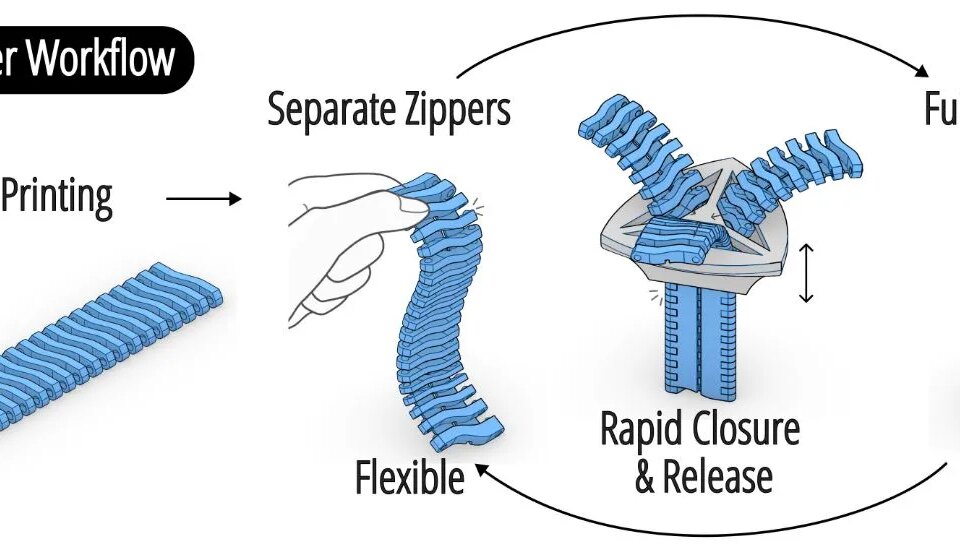

We treat software modularity and hardware modularity as separate problems at our peril. In a world where “infrastructure as code” has become a guiding principle for digital systems, there is growing value in treating physical structures with the same mindset: declarative, reversible, and optimized for rapid iteration. A recent research prototype – a 3D-printable “Y-zipper” that converts flat, flexible strips into rigid three‑dimensional rods and helices – is a small but important example of that shift.
Context
I recently came across a project where researchers designed a zipper-like, 3D-printable mechanism (the Y-zipper) that interlocks teeth to turn floppy 2D strips into stiff 3D forms. It uses materials such as PLA and TPU, supports curved geometries and automatic actuation, and demonstrates modular joints and fabric integration for reversible assembly.
What this signals for product and systems architects
1. Physical primitives matter. In software, primitives like containers or REST allow composability. The Y-zipper suggests comparable physical primitives for rapid, reversible construction: lightweight, printable elements that snap together to form structural members. For product teams, this reduces the distance between idea and deployed prototype – not just for look-and-feel, but for usable mechanics and load-bearing behaviour.
2. Build vs. buy – revisit with fabrication in the loop. For many startups and enterprises, outsourcing hardware to established manufacturers is the default. But low-cost digital fabrication (3D printing, TPU bridges, integrated textiles) changes the calculus. For early-stage product-market fit, “build locally, iterate frequently” can beat “buy at scale” because it shortens feedback loops and exposes real-world failure modes sooner.
3. Design for reversibility and maintenance. The Y-zipper’s reversible assembly reduces single-use consumption and simplifies repairs. From an enterprise perspective, that lowers lifecycle costs and aligns with circularity goals – provided material choices and joinery are engineered for longevity and predictable degradation.
4. Trade-offs and constraints to account for. PLA and TPU are excellent for prototyping but have environmental limits (UV, temperature, creep) and structural ceilings – the researchers estimated practical lengths before failure (about 3 meters). Any production or field-deployment plan must include rigorous materials testing, modular redundancy for longer spans, and certification if human safety is involved. Expect trade-offs: speed of deployment vs. ultimate load capacity; customizability vs. standardization.
Actionable guidance for CTOs and founders
– Invest in a small digital fabrication cell (printer + materials lab + test rig). It pays back quickly in product insight.
– Treat physical joinery as an interface contract. Define mechanical interface standards early so components from different teams or suppliers interoperate.
– Prototype at scale. Move beyond token 3D prints to load-tested, repeated-cycle prototypes that reveal wear and edge cases.
– Plan for supply-chain hybridity. Use local printing for rapid iterations and vetted manufacturers for volume runs; maintain design-for-manufacture (DFM) discipline.
– Consider regulatory and safety pathways early if a product will bear load or serve in public deployments.
A pragmatic Bharat connection
This sort of reversible, 3D‑printed structural primitive has clear relevance for regions like Northeast India. Rapidly deployable, lightweight supports for temporary shelters, health camps, or community infrastructure could be manufactured locally by district-level makerspaces. The ability to ship flat, print locally, and assemble on site aligns with last‑mile constraints and frugal innovation practices already prevalent in many Indian states. That said, field adoption will require local material validation and community training on maintenance and safe assembly.
Takeaways
– Think of physical parts as composable, versioned interfaces – not one-off artefacts.
– Use local digital fabrication to accelerate learning; defer heavy manufacturing until the design stabilizes.
– Prioritize reversibility and repairability to reduce lifecycle cost and environmental impact.
– Validate materials and joints under realistic conditions before any public or safety-critical deployment.
Closing thought
The most profound innovations often come from shifting a familiar abstraction into a new domain. Treating physical structures as programmable, composable systems invites a wave of practical, sustainable, and locally empowered design – and that is a design problem worth pursuing.
About the Author Sanjeev Sarma is the Founder Director of Webx Technologies Private Limited, a leading Technology Consulting firm with over two decades of experience. A seasoned technology strategist and Chief Software Architect, he specializes in Enterprise Software Architecture, Cloud-Native Applications, AI-Driven Platforms, and Mobile-First Solutions. Recognized as a “Technology Hero” by Microsoft for his pioneering work in e-Governance, Sanjeev actively advises state and central technology committees, including the Advisory Board for Software Technology Parks of India (STPI) across multiple Northeast Indian states. He is also the Managing Editor for Mahabahu.com, an international journal. Passionate about fostering innovation, he actively mentors aspiring entrepreneurs and leads transformative digital solutions for enterprises and government sectors from his base in Northeast India.