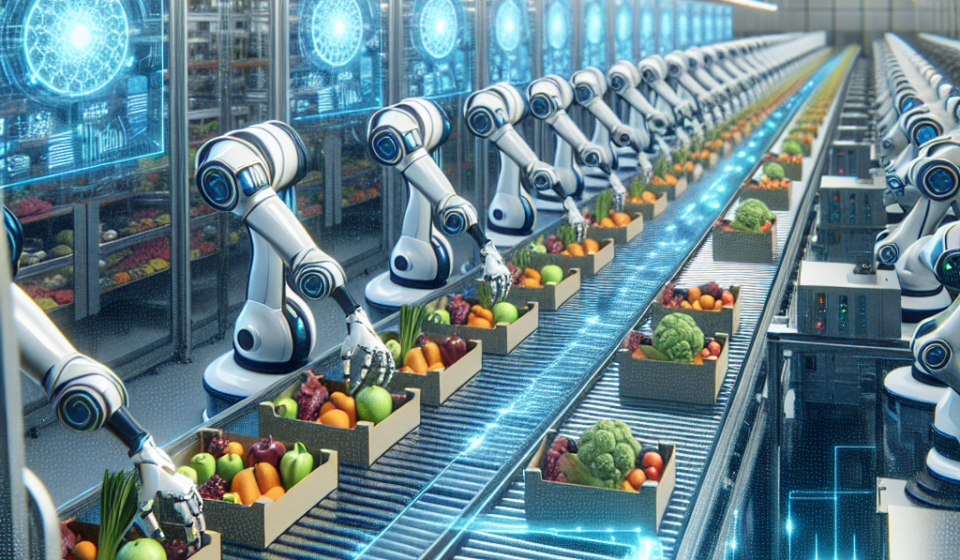

We often treat food automation as a solved engineering puzzle-conveyor belts, vision checks, and packaging machines. The reality is messier: whole produce is irregular, fragile, and unforgiving of the slightest mis-pick. So when I read a recent announcement from Chef Robotics about robots that can now automate tray assembly for produce packing, what stood out to me wasn’t the novelty of a robot doing pick-and-place. It was the practical leap: moving from brittle, deterministic automation toward adaptable physical AI that tolerates real-world variability.
Context (the signal)
Chef Robotics announced a produce-packing application that combines piece-picking for discrete fruits and scooping for portionable items, driven by camera-based tray tracking and physical AI models. The system aims for consistent retail-ready placement, multi-item single-pass packing, and layered stacking-delivered as part of their Robotics-as-a-Service model.
Analysis – what this means for enterprises and architects
The strategic implication is clear: robotics is evolving from rigid automation islands into software-defined, perception-driven production components. That shift carries several architectural and operational consequences:
– From deterministic control to perception-first design. Traditional packaging lines assume uniform inputs and fixed fixtures. Physical AI accepts-and adapts to-variance. For systems architects, this means designing pipelines that expose perception outputs as first-class signals: confidence scores, object centroids, grasp poses, and exception flags. These are inputs for orchestration, not black-box hardware details.
– Integration is the hard part. A robot that can place fruit still needs to participate in the factory’s broader digital ecosystem: MES/WMS, quality inspection cameras, weight-check scales, traceability logs (e.g., FSSAI compliance in India), and ERP for pricing and SKUs. Plan for standardized data contracts and an event-driven integration layer rather than one-off point integrations.
– Build vs. Buy becomes tactical, not dogma. RaaS models lower capital barriers for pilot and scale-but introduce questions of vendor lock-in, support SLAs, and edge compute sovereignty. For many MSMEs, RaaS will be the fastest path to automation; for high-volume processors, owning bespoke perception stacks and simulation environments may be more cost-effective long-term.
– People & process are as important as throughput. Automation here reduces repetitive manual tasks but raises new roles: robot maintenance, vision model validation, and exception management. A pragmatic adoption plan should include targeted reskilling and measured productivity metrics (throughput, pack yield, rework rate, and contamination incidents).
– Operational resilience and safety. Food environments are wet, dusty, and regulated. Any deployment must bake in hygiene practices, redundant sensors, remote diagnostics, and safe fallback states. Design decisions that prioritize uptime over marginal speed wins will pay off in regulated food supply chains.
Localization – why this matters to India (and Northeast India specifically)
This technology aligns with genuine needs in India’s fragmented food processing sector. Small and medium plants face high labor costs, inconsistent quality, and limited access to capital for bespoke automation. RaaS and modular physical AI tools could let Indian packers standardize presentation, reduce spoilage, and access institutional buyers (airlines, hospitals, retail chains). For Northeast India, with its rich horticulture and growing cold-chain initiatives, adaptable tray packing could convert perishables into higher-value packaged products for national and export markets-provided deployments account for intermittent connectivity, local packaging formats, and local regulatory traceability requirements.
Actionable takeaways for CTOs and founders
– Run a focused pilot: pick one SKU, define clear success metrics (pack accuracy, cycle time, yield), and measure for a minimum of 30 production shifts.
– Specify data contracts: require perception outputs, confidence thresholds, and an exception API from vendors.
– Treat RaaS like a partnership: negotiate SLAs for uptime, model retraining cadence, and edge-update policies.
– Invest in people transition: certify three to five operators/technicians per line for maintenance and exception handling.
– Plan for traceability and compliance: integrate robot logs with your food-safety records and ERP.
Closing thought
Physical AI isn’t about replacing hands; it’s about extending what factories can do reliably at scale-turning variability from a production risk into a signal the system can act on. For leaders, the question is no longer whether to automate produce packing, but how to do it in a way that composes cleanly into the broader digital factory and sustains people and process through the change.
About the Author Sanjeev Sarma is the Founder Director of Webx Technologies Private Limited, a leading Technology Consulting firm with over two decades of experience. A seasoned technology strategist and Chief Software Architect, he specializes in Enterprise Software Architecture, Cloud-Native Applications, AI-Driven Platforms, and Mobile-First Solutions. Recognized as a “Technology Hero” by Microsoft for his pioneering work in e-Governance, Sanjeev actively advises state and central technology committees, including the Advisory Board for Software Technology Parks of India (STPI) across multiple Northeast Indian states. He is also the Managing Editor for Mahabahu.com, an international journal. Passionate about fostering innovation, he actively mentors aspiring entrepreneurs and leads transformative digital solutions for enterprises and government sectors from his base in Northeast India.