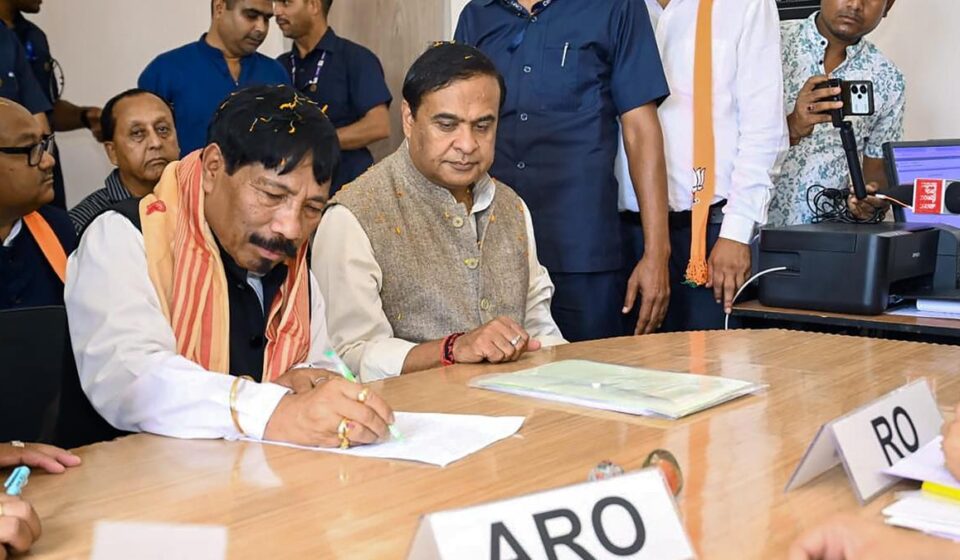

Atul Bora, the president of the Asom Gana Parishad (AGP) and its candidate for the Bokakhat constituency, filed his nomination on Monday, accompanied by Assam Chief Minister Himanta Biswa Sarma in Golaghat. As the AGP grapples with electoral challenges, it finds itself overshadowed by the upstart Raijor Dal, which emerged after the anti-Citizenship (Amendment) Act protests. While the Raijor Dal, led by Akhil Gogoi, holds just one seat in the outgoing Assembly, it has recently wrested 11 seats from Congress, illustrating its growing influence.
The AGP, a junior partner in the ruling National Democratic Alliance led by the BJP, has been allocated 26 seats for the upcoming elections, matching its previous count. Nonetheless, the constituencies it occupies signal a concerning trend. While Bora retains his Bokakhat seat and Keshab Mahanta continues in Kaliabor, other AGP candidates face significant hurdles. Diptimayee Choudhury has been renominated for Barpeta, while Prithviraj Rabha will defend his Tezpur seat. However, Prodip Hazarika’s shift to Sivasagar reflects broader concerns regarding AGP’s standing post-delimitation.
This scenario marks a stark contrast to the AGP’s historical triumphs, having originally surged to power in the mid-1980s during the Assam Agitation. This time, the AGP has nominated a record 13 candidates from the minority community, a move attributed to “winnability arithmetic,” according to Bora. However, this strategic choice underscores the challenges the AGP faces, as the BJP has refrained from fielding Muslim candidates among its 89 nominees, placing additional pressure on its ally.
Recent changes have sparked internal discontent within the AGP. The omission of veteran MLA Ramendra Narayan Kalita, a five-time representative from Guwahati West, raises eyebrows. While cited as a casualty of delimitation, many argue he could have contested from the newly-formed Guwahati Central seat, which has been handed to Vijay Kumar Gupta instead.
Notably, grassroots tensions are emerging in constituencies like Dergaon, Khumtai, and Barhampur, where AGP supporters feel sidelined. The AGP has been completely excluded from these key areas, despite a historical association, most notably in Barhampur, where former Chief Minister Prafulla Kumar Mahanta was twice elected.
The AGP’s declining influence vis-à-vis the BJP mirrors sentiments from the 2021 elections, during which the AGP contested 26 seats but secured only nine victorious outcomes. Several traditional AGP strongholds were seized by the BJP, contributing to its ongoing decline.
Historically, the AGP allied with the BJP during the 2001 Assembly elections, which resulted in a loss of power and a significant seat drop. From a peak of 59 seats in 1996, the AGP fell dramatically, while its partner rose to prominence. As the election cycle approaches, the AGP may struggle to match its previous win count, despite some potential advantages, including the influx of incumbents from the Barak Valley and the BJP’s established voter base.
As the AGP navigates this turbulent landscape, the balance of power within Assam’s political arena continues to shift, raising pivotal questions about the future of regional parties in the state.
Original Source: https://www.thehindu.com/elections/assam-assembly/headline-numbers-mask-agps-steady-slide-despite-10-years-in-power/article70777121.ece
Category : Assam
Tags:
Publish Date: 2026-03-24 00:16:00