Do you want the SEO title in English, or in Assamese to match the original text’s dominant language?

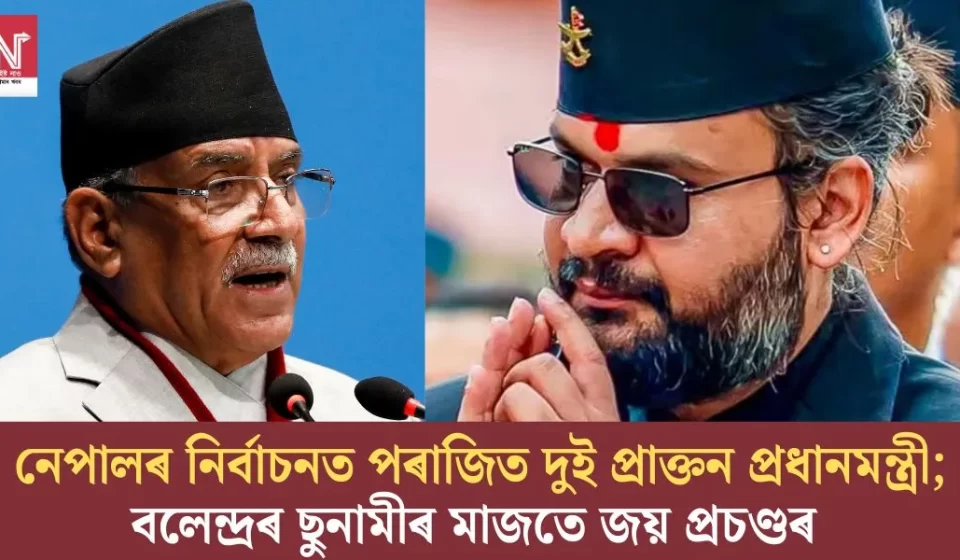
Nepal’s general election produced a dramatic shake-up as the Rastriya Swatantra Party surged toward an overwhelming victory and two former prime ministers were defeated, while another — Pushpa Kamal “Prachanda” Dahal — retained a seat. By Sunday evening, results for 120 of the 156 constituencies had been declared, with the newly formed Rastriya Swatantra Party (established in 2022) winning a commanding share of seats and appearing poised to secure a comfortable parliamentary majority. Kathmandu Mayor Balendra Shah’s party reportedly captured roughly two-thirds of declared seats, positioning him to become Nepal’s next prime minister.
The results reflect a wider generational shift. Last September’s youth-led protests, driven by Gen Z demands for change, boosted parties seen as alternatives to the old order. The Rastriya Swatantra Party has emerged as a clear beneficiary, winning strong support from younger voters and urban constituencies.
Balendra Shah scored a high-profile victory in Jhapa-5, defeating four-time prime minister KP Sharma Oli by more than 50,000 votes. Oli, who resigned as prime minister on September 9 last year amid Gen Z-led protests, had long relied on Jhapa-5 as a political bastion; Shah’s decisive win there underscored the scale of the political shift.
Former prime minister Madhav Kumar Nepal also lost his contest in Rautahat-1, falling to Rajesh Kumar Chaudhary of the Rastriya Swatantra Party. Another former premier, Baburam Bhattarai — leader of the Progressive Democratic Party — filed a nomination for Gorkha-2 but later withdrew it.
Pushpa Kamal Dahal, popularly known as Prachanda, won from Rukum East. Prachanda has a pattern of contesting new constituencies; he ran from Gorkha-2 in 2022 and from Chitwan-3 earlier in his career. “Prachanda always looks for new and safer constituencies. Rukum East was once a Maoist stronghold; that’s why he chose it,” former MP Sunil Babu Panta said, noting Prachanda’s tactical moves. The veteran leader has also reorganized his party under the name Nepali Communist Party.
Beyond the former premiers, several other heavyweight politicians were upset in this election, signaling broad voter appetite for change. The outcome marks a notable realignment in Nepalese politics, with a new party capitalizing on youth discontent and established leaders facing electoral rebuke.
Original Source: https://assam.nenow.in/two-former-prime-ministers-defeated-in-nepals-elections-as-prasanda-wins-amid-balendras-tsunami/
Category: অসম,আন্ত: ৰাষ্ট্ৰীয়,উত্তৰ-পূব,নেপাল,শীর্ষ সংবাদ
Tags:
Publish Date: 2026-03-09 09:48:00