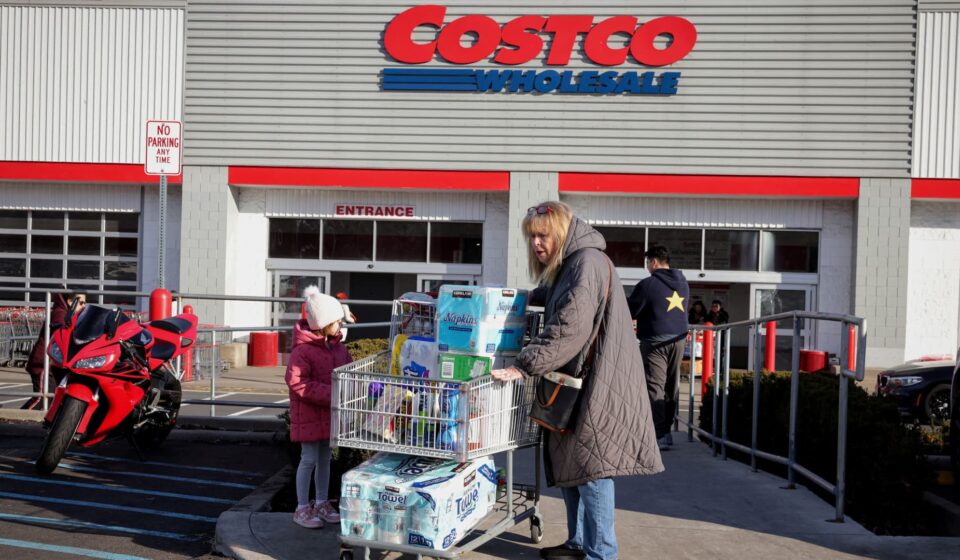

Costco Wholesale reported robust quarterly results, edging past analyst projections and showcasing its sustained sales momentum. For the second quarter of fiscal 2026, the retailer’s total revenue soared 9.2% year over year to $69.6 billion, surpassing Wall Street’s anticipated $69.12 billion, according to data from LSEG. Adjusted earnings per share (EPS) for the 12-week period ending February 15 climbed 13.9% from the previous year, reaching $4.58, outperforming the consensus expectation of $4.56. Despite these encouraging results, Costco’s stock saw little movement in after-hours trading. However, the beginning of 2026 has proven more favorable for shareholders compared to the last six months of 2025, which marked the retailer’s first consecutive quarterly declines since 2022. Year-to-date, shares have risen approximately 14%.
The question now is whether Costco can continue this momentum and reclaim its peak from mid-2022. On one hand, the impressive 6% to 7% growth in comparable sales month after month indicates the company is gaining market share amid a fiercely competitive retail environment. Strong traffic and ticket sales reflect this upward trend. Yet, membership renewal rates remain a concern, having declined over recent quarters. This trend appears less a reflection of the value Costco offers and more a consequence of an influx of online sign-ups who may not fully appreciate the benefits of in-store shopping. While comp sales growth demonstrates resilience, the company’s profitability is significantly tied to membership fees, so lower renewal rates could hinder future growth.
In reviewing Thursday’s earnings, there were mixed feelings. Although the global renewal rate stabilized at 89.7%, the U.S. and Canada saw another decrease, indicating this challenge may persist for some time. CEO Ron Vachris emphasized ongoing improvements in customer experience through technology investments, such as enhanced mobile payment systems and pre-scan technology, which streamline checkout processes. These initiatives have enabled Costco to manage heightened growth with steady staffing levels. Vachris also mentioned pilots for automated pay stations, which promise to expedite transactions further, reflecting a positive shift in customer flow within warehouses.
CFO Gary Millerchip noted that rising gas prices generally drive more traffic to Costco, as members are inclined to fill up their tanks and shop in-store simultaneously. “If gas prices start to increase, our value proposition tends to resonate better with members,” he stated. With strong comparable sales and a stabilization of worldwide renewals-though some challenges remain in the U.S. and Canada-Costco is poised for a promising outlook. Nevertheless, considering the current environment, a cautious approach is warranted, leading to a maintained hold-equivalent 2 rating on shares, with the price target nudged up to $1,100 from $1,050.
During the fiscal second quarter, comparable sales rose 7.4% reported, and 6.7% adjusted, indicating a solid performance amid challenging conditions. Growth was bolstered by a 3.1% increase in traffic and a 4.2% rise in ticket size. Notably, digitally-enabled comparable sales skyrocketed by 22.6%. The success wasn’t limited to general merchandise; fresh food sales also saw significant gains. While total paid memberships grew 4.7% year-over-year to 82.1 million, this was below FactSet’s consensus estimate of 82.7 million, demonstrating the ongoing struggles with renewal rates, particularly among online sign-ups. Despite these setbacks, Costco opened three new warehouses during the quarter, with plans for 18 more for the fiscal year, signaling an ambitious growth strategy.
Original Source: https://www.cnbc.com/2026/03/05/were-raising-our-costco-price-target-after-a-good-but-not-great-quarter-heres-why.html
Category :
Tags:
Publish Date: 2026-03-06 05:57:00