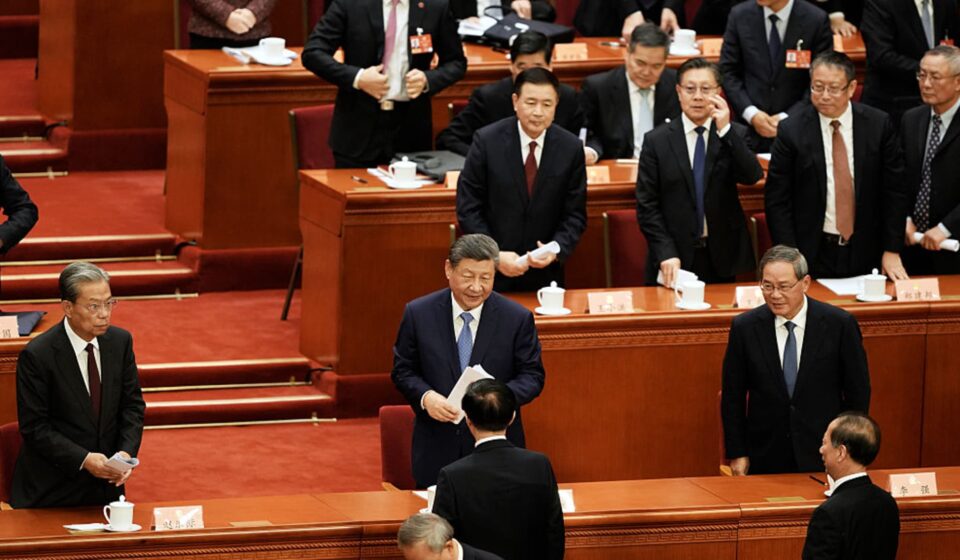

Xi Jinping, the President of China, opened the Chinese People’s Political Consultative Conference (CPPCC) on March 4, 2026, where the government announced a GDP growth target of 4.5% to 5%. This figure is the lowest target recorded since the early 1990s and reflects Beijing’s challenges amid ongoing deflationary pressures and strained trade relations with the United States. The target has been downgraded from the previous “around 5%” set over the last three years, making it the most modest goal since 2020, when no target was established due to the pandemic.
The budget deficit remains unchanged at approximately 4% of GDP, consistent with last year’s figures. This target, initially set in 2024, is the highest recorded since 2010, surpassing the 3.6% deficit seen in 2020. Policymakers have also maintained the annual consumer inflation target at “around 2%,” the lowest in over two decades, indicating Beijing’s recognition of weak domestic demand. For 2025, inflation was virtually stagnant at 0.7% when excluding food and energy, signaling subdued consumer confidence.
Premier Li Qiang addressed various economic challenges in his report, highlighting the “dramatically changing international trade and economic environment” alongside “deep-rooted structural problems” affecting consumption and investment growth. Tianchen Xu, a senior economist at the Economist Intelligence Unit, remarked that the 4.5% to 5% target reflects a shift from prioritizing high growth rates to a focus on sustainable quality, suggesting that high growth could lead local officials to resort to expensive but unproductive investments.
Additionally, the government aims to maintain the urban unemployment rate, which stood at 5.2% last year, at about 5.5% for this year and create 12 million new jobs in urban areas. To support the economy, China plans to issue 1.3 trillion yuan (approximately $188.5 billion) in long-term special treasury bonds, consistent with last year’s issuance. The report also allocates 250 billion yuan for a consumer goods trade-in program and another 300 billion yuan to bolster capital at large state-owned banks.
Li emphasized that the scale of government spending will remain substantial, with a focus on enhancing consumption and living standards. This cautious fiscal approach aligns with the conservative growth target set for the year. Moreover, China will adopt an “appropriately accommodative” monetary policy to further stimulate growth, including potential interest rate cuts and adjustments to the reserve requirement ratio.
As the annual parliamentary session, known as the “Two Sessions,” unfolds, discussions on economic and financial policies are anticipated. China’s economy expanded by 5% last year, but the nation is grappling with a prolonged period of deflation, compounded by a real estate slump, lackluster consumer confidence, and local government debt challenges. Retail sales grew by 3.6% in 2025, yet fixed-asset investment saw a decline of 3.8%, marking the first annual downturn in decades, exacerbated by a 17.2% fall in real estate sector investment.
Presently, China is navigating the complex landscape of a trade war with the U.S., shifting its export focus toward Europe and Southeast Asia. In remarks highlighting the impact of U.S. tariffs, Premier Li noted last year’s stimulus measures that helped mitigate the effects of this trade tension. The geopolitical landscape worsens with ongoing conflicts in the Middle East, influencing upcoming diplomatic interactions between Xi Jinping and U.S. President Donald Trump, expected to cover topics including tariffs and export controls. Amidst these challenges, China continues to advocate for diplomatic solutions in international conflicts, emphasizing its role as a mediator.
Original Source: https://www.cnbc.com/2026/03/05/china-gdp-two-sessions-.html
Category :
Tags:
Publish Date: 2026-03-05 08:53:00