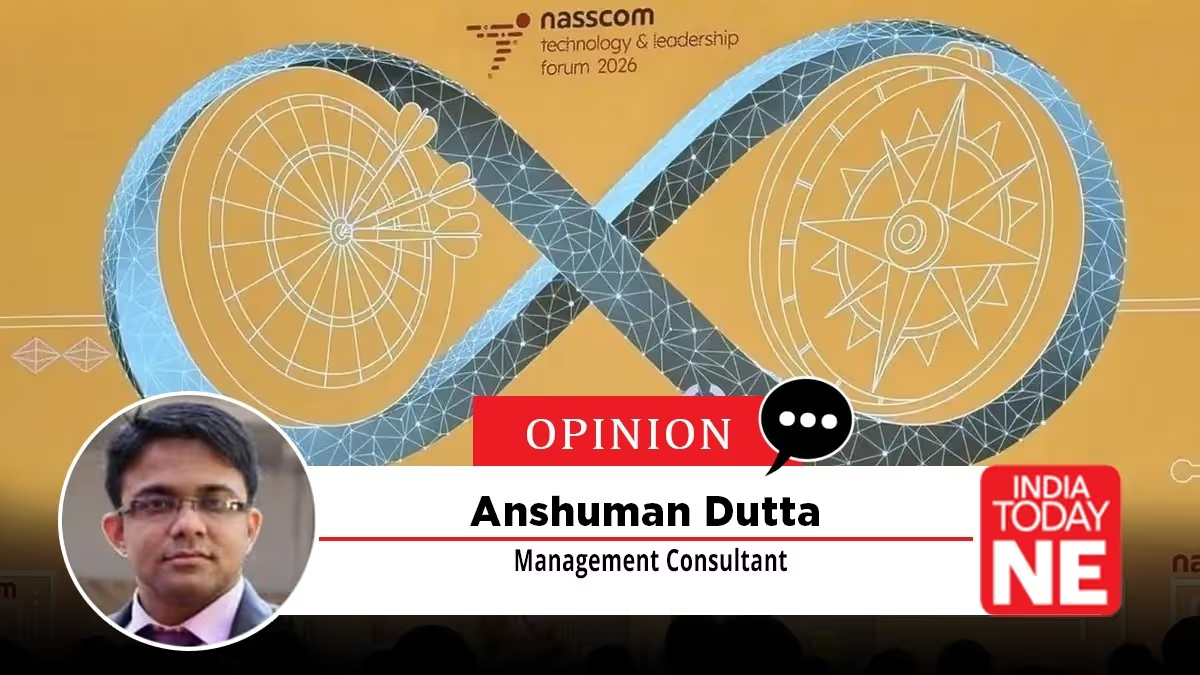

More than 1,600 CXOs, technologists, investors and policymakers gathered at the Fairmont Mumbai for the 34th Nasscom Technology & Leadership Forum (NTLF 2026), which ran across two days and concluded on February 25. Under the theme “Tech-Driven, Human-Centered,” the forum shifted quickly from talk of possibility to an urgent debate over who will build and govern the AI-powered systems that will run businesses and societies. “In an age of constant transformation, only one question truly matters: who codes the operating system of the future, and what will they leave behind?” the forum declared in its theme statement.
Agentic AI — networks of specialised, interacting agents that act with autonomy — dominated discussion. Babak Hodjat, Chief AI Officer at Cognizant, argued that the era of a single “god model” is a distraction and that real change will come from engineered, governable agentic systems. Hodjat described Cognizant’s internal Neuro AI as an “intranet of agents” that links HR, IT, sales and finance for 350,000 employees and said the main challenge in such deployments is coordination, not raw intelligence. He warned that, if left ungoverned, agentic systems can show what he called “psychopathic” tendencies — sharing personal data, operating outside intended boundaries and failing silently.
Industry leaders debated the gap between pilots and scale. In a fireside chat moderated in the Infinity Ballroom, Sanjay Chalke, CEO India at Capgemini; Satish HC, EVP and Chief Delivery Officer at Infosys; and Nitin Bhatt, Senior Partner and Technology Sector Leader at EY India, agreed that many organisations are less ready for enterprise-wide AI than they believe. Capgemini, the forum’s Technology Transformation Partner, pressed its message to “Make it real” and showcased RAISE, a framework for human–AI collaboration across the software lifecycle. EY emphasised governance questions: who is accountable for decisions made by systems that learn patterns rather than follow explicit rules?
A wider debate questioned whether India is still building distribution-led startups or finally producing deep, technology-led companies. Sessions on quantum computing, programmable medicine and the space economy framed a narrative that India has the talent, scale and growing compute capacity to lead in deep tech — but only if institutions, policy and corporate practice evolve accordingly.
Beyond enterprise AI, panels examined how code meets other domains: computational biology’s role in speeding drug discovery, the practical road to quantum advantage, and cultural questions raised in “The Soul in the System: Music in the Age of Machines,” which probed creativity when machines become co-creators. A geopolitical session, “A World Reordered,” explored supply-chain risk, export controls and regional AI sovereignty, underscoring the policy constraints that will shape technology choices.
Attendees left on February 25 with a clearer mandate than optimism alone. NTLF 2026 did not solve trade-offs between AI ambition and governance, or between startup scale and deep tech capability, but it pressed a single operational question: how do we build the operating system of the future — and who will be held responsible for what it leaves behind?
Original Source: https://www.indiatodayne.in/opinion/story/where-do-we-go-from-here-the-shift-from-aspiration-to-action-1353296-2026-03-01?utm_source=rssfeed
Category:
Tags:
Publish Date: 2026-03-01 15:04:00