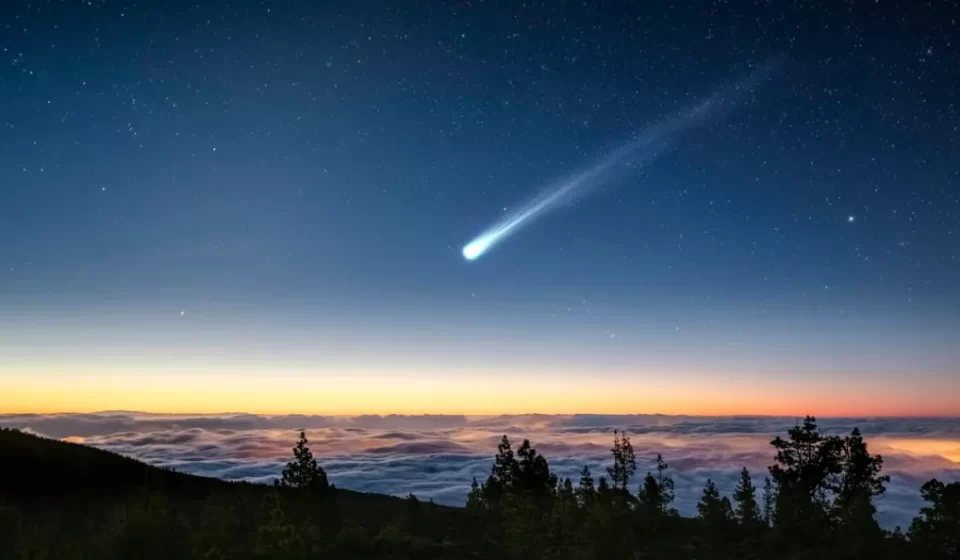

A newly discovered comet, C/2026 A1 (MAPS), could become one of 2026’s most spectacular sky events if it survives a dangerously close pass by the Sun. First observed in January 2026 by amateur astronomers Alain Maury, Georges Attard, Daniel Parrott and Florian Signoret (the MAPS team), the comet was spotted at about 2.056 AU from the Sun, a distance that implies a relatively large nucleus roughly 2.4 km across. Its close approach — or perihelion — is predicted for April 4–5, 2026, when it will skim to about 191,000 km above the Sun’s surface.
The object belongs to the Kreutz family of sungrazing comets, fragments of a much larger progenitor that fragmented centuries ago. Detecting the comet from Chile at more than 300 million kilometres (roughly the 2.056 AU reported) highlights the sensitivity of the observers’ equipment and the value of experienced amateur contributions to discovery. Orbital calculations show a highly elongated path with an orbital period of approximately 850 years.
As the comet nears perihelion, intense solar heat should vaporize surface ices and produce a bright coma and an extended tail, described in initial reports as turquoise in hue. Early estimates place the peak brightness as low as magnitude −1 or even brighter; if dust production is unusually high the comet might rival Venus or, in exceptional circumstances, approach the brightness of a full Moon. Survival through perihelion is uncertain: Kreutz sungrazers commonly break apart under tidal forces and extreme heating, though some — notably C/2011 W3 (Lovejoy) — have endured and become brilliant displays.
Observers in India have the best chance in early April evenings. Look low toward the southwest about 30–45 minutes after sunset; southern states such as Tamil Nadu and Kerala, with broader western horizons, offer more favorable views. Northern locations may be limited by obstructed western horizons. The perihelion peak on April 4–5 could produce daytime visibility if the comet survives close approach, and instruments such as SOHO are expected to record its passage as it moves within about 0.56 AU and closer later in April.
The discovery and follow-up illustrate the growing importance of pro-am collaborations: amateur searches supply discoveries while professional and space-based observatories provide detailed monitoring. Whether C/2026 A1 (MAPS) fragments or survives, the event will yield valuable data on sungrazing comets and the solar corona. Use astronomy apps (for example Star Walk) for real-time tracking, observe from a safe location, and never look directly at the Sun without proper solar filters. Weather conditions in April will govern actual visibility.
Original Source: https://www.jagranjosh.com/current-affairs/comet-c2026-a1-maps-will-the-bright-sungrazer-be-visible-from-india-1850000711-1
Category:
Tags:
Publish Date: 2026-02-26 00:23:00